Agentic AI Meets Distributed File Services, Powering a New Era of Digital Teamwork
By Jimmy Tam, CEO, Peer Software
As GPUs, high-bandwidth memory, and specialized accelerators become scarce and expensive, compute is consolidating into fewer locations with massive hyperscale and enterprise “AI factories” designed to maximize utilization of limited resources. Trillions of dollars are being invested globally in AI data centers. Major AI providers are securing a large share of the world’s available memory and accelerator supply to meet demand for model training and inference. The result is a widening imbalance between supply and demand – especially for enterprises that lack the scale or capital to compete directly for scarce GPUs.
This imbalance is forcing organizations into difficult choices, including consolidating compute into one or two centralized data centers, offloading workloads to the public cloud, or accepting longer timelines and higher costs. But while compute is becoming increasingly centralized, data is moving in the opposite direction. AI relies on data, and such data is ubiquitous.
Enterprise data is inherently distributed, generated and stored across branch offices, manufacturing facilities, research environments, cloud platforms, edge locations and partner ecosystems. It resides on a wide range of storage systems, including on-premises file servers, NAS platforms, object storage, and cloud file services, each typically managed in isolation and optimized for localized operational needs.
This fragmented data landscape presents a foundational challenge for AI initiatives. Training and inference require timely, reliable access to vast amounts of data. Yet moving all that data to centralized AI infrastructure is impractical, costly, and, in many cases, impossible due to latency, bandwidth constraints, regulatory requirements, or operational downtime. Simply put, the data cannot all be pulled into a single place to meet the compute requirements.
Agentic AI represents a shift from passive models to autonomous systems. Rather than responding to a single prompt, AI agents continuously operate across workflows while analyzing information, coordinating tasks, triggering actions and collaborating with both humans and other agents. For distributed digital teams, this has profound implications. Agentic AI systems do not operate in isolation. They require persistent access to datasets, shared project files, operational records and real-time outputs generated by people and systems across the organization. They must understand context, track changes and respond dynamically as data evolves.
This level of autonomy cannot be achieved by copying static datasets into centralized AI pipelines. Agentic AI demands a live, unified view of distributed data, without breaking existing workflows or forcing wholesale infrastructure consolidation.
Distributed File Services as the Missing Layer
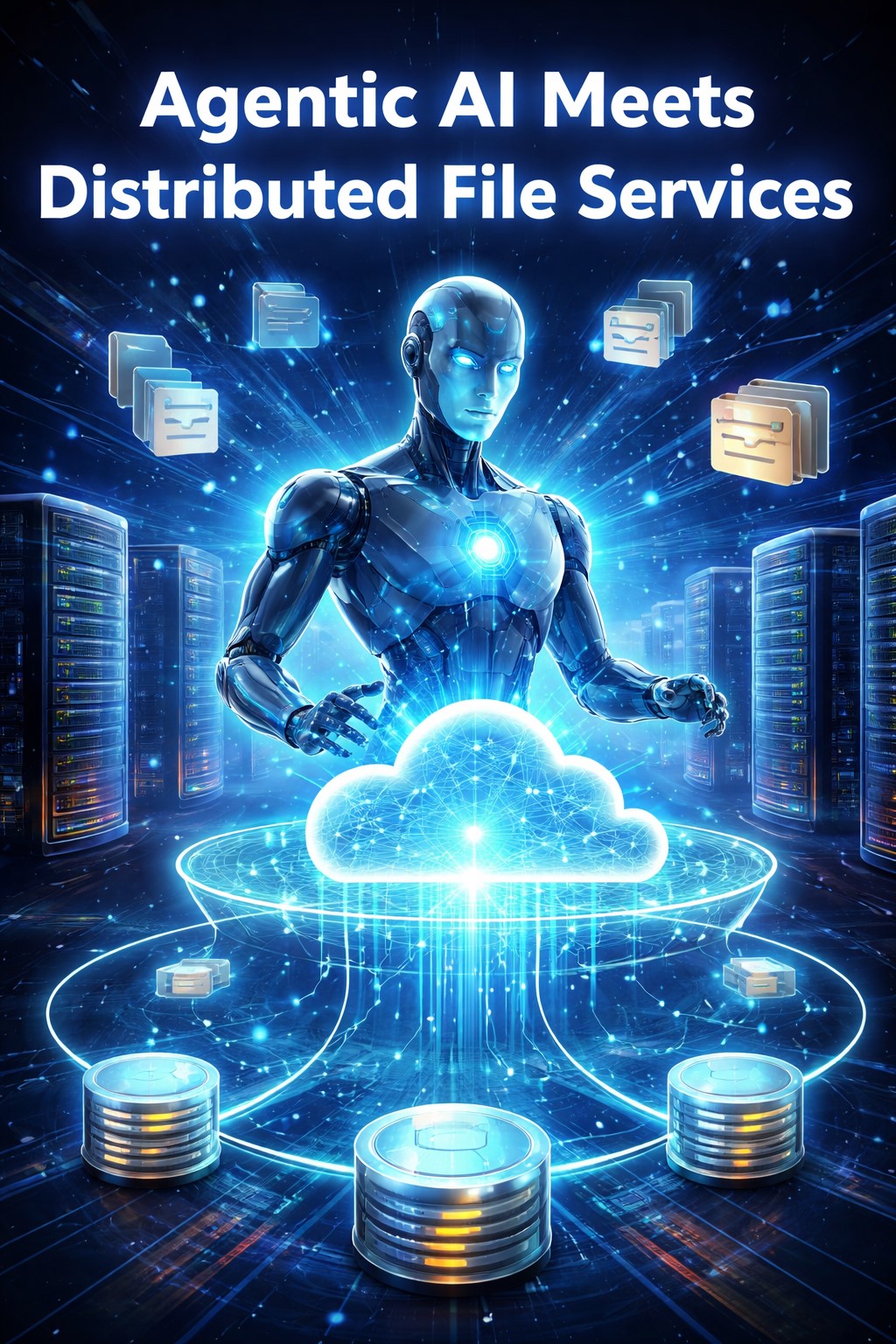
Distributed file services connect centralized compute resources with data that lives across many systems and locations. They create a consistent, synchronized file system across disparate storage platforms and locations, allowing users and applications to access data regardless of where it is stored. When paired with Agentic AI, distributed file services unlock a new architectural model:
- Data remains where it is created, optimized for local performance, compliance, and resilience.
- Compute can reside where it is most efficient, whether in hyperscale AI data centers or cloud environments.
- AI agents operate across both, accessing and orchestrating data across the ecosystem.
This convergence enables AI systems to reason over enterprise-wide data in real time, while allowing human teams to continue working in familiar environments. Instead of forcing organizations to choose between centralized AI and distributed operations, it allows them to have both.
As Agentic AI matures, organizations will increasingly rely on hybrid teams of humans and AI agents, inspiring confidence in future-ready, innovative collaboration models.
AI agents can monitor file changes, detect patterns, flag risks, and recommend actions. Human teams benefit from reduced friction, faster insights and seamless collaboration without needing to understand the underlying complexity of AI infrastructure.
What’s Next?
The future of AI will not be defined solely by larger models or faster GPUs. It will be defined by architecture and how intelligently organizations connect compute, data and people.
The convergence of Agentic AI and distributed file services marks a foundational shift in how work gets done. It enables enterprises to move beyond isolated AI experiments and toward truly intelligent, distributed digital teams that can operate at a global scale.
In a world where both data and compute have gravity, the winners will be those who build systems that respect both and bring them together.

Jimmy Tam is the CEO of Peer Software, a global software company focused on simplifying file management and orchestration for enterprise organizations since 1993. Jimmy is a 25-year veteran in enterprise software solutions and works daily with customers and partners on the architecture, planning, and design of IT infrastructure solutions that meet the complex demands of storage, access, protection, and sharing across distributed employees, partner firms, and customers.