Your Employees Are Using AI Right Now. You Probably Don’t Know About It

Shadow AI is the next shadow IT. And most businesses aren’t ready for what that means.
Cast your mind back to the early days of cloud storage. Employees started using Dropbox to share files because it was faster than the company server. IT departments had no idea. Then came the data breach audits, the compliance headaches, and the scramble to put policies in place after the fact.
We’re living through the same moment with AI. Except this time, the stakes are higher.
The Invisible Adoption Problem
I speak to business owners every week. When I ask them to name the AI tools their team are using, most of them go quiet.
Not because their teams aren’t using AI, they are – daily, but because nobody told the business owner it was happening.
ChatGPT. Microsoft Copilot. Google Gemini. Notion AI. Grammarly. These tools are embedded into how people work now. They sit in browsers, in email clients, in document editors. They’re free, fast, and genuinely useful. And your employees found them without waiting for permission.
This is what’s being referred to in the industry as ‘Shadow AI’ – the use of AI tools outside of any official company policy, procurement process, or governance structure. It’s the modern equivalent of shadow IT, except instead of unauthorised software installs, we’re talking about tools that can process, store, and learn from anything your employees feed into them.
And they’re feeding in a lot.
What’s Actually Going Into These Tools
Here’s what I see in practice. A customer service manager pastes a client complaint into ChatGPT to help draft a response or a finance assistant uses an AI tool to summarise a spreadsheet containing salary data or A HR manager uploads a job description (along with a shortlist of candidate CVs) to get AI-generated interview questions.
None of these people are being reckless. They’re solving real problems quickly with tools that work. But in each of those scenarios, sensitive data has left the building. Client information. Employee records. Proprietary financials. It’s gone into a system the business has no visibility over, no contractual relationship with, and no ability to audit.
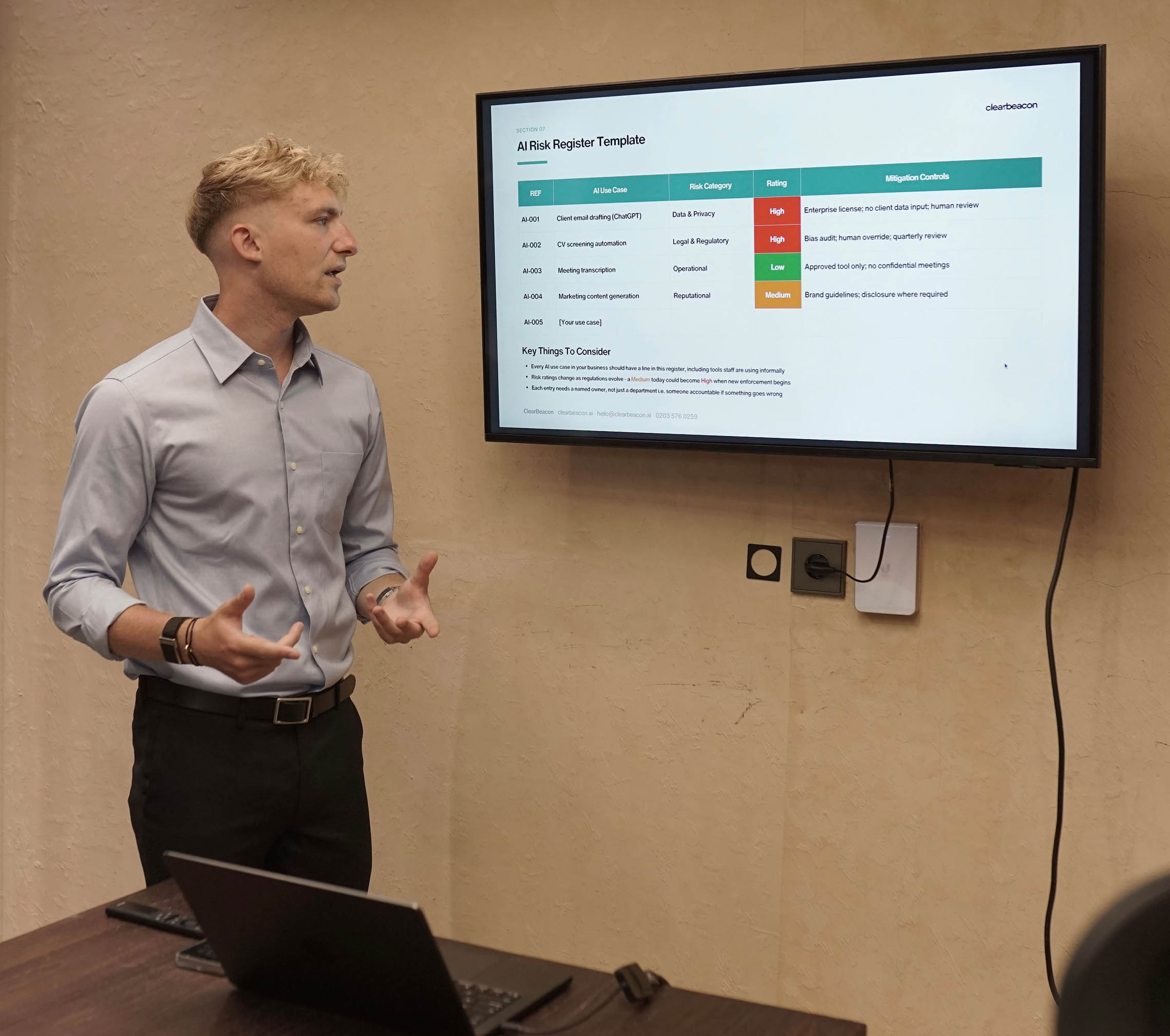
Most employees have no idea that general AI tools can retain, use, or process the data they input if you . The assumption is that it works like a search engine – you ask, you get an answer, it disappears. That’s not how it works. And nobody has told them otherwise, because there’s no policy in place to do so.
Why This Is About to Become Urgent
This would be concerning enough on its own. But the EU AI Act changes the stakes significantly.
The Act, which is now in enforcement, places legal obligations on any business that deploys or uses AI systems – not just the companies that build them. That includes your business, if your employees are using AI tools as part of their work.
Under the Act, organisations are expected to understand the AI systems in use across their operations, assess the risks those systems pose, and be able to demonstrate that appropriate controls are in place. There are also obligations around transparency, data protection, and human oversight that intersect directly with how AI tools are used day-to-day.
GDPR doesn’t go away either. Feeding personal data into an AI tool that processes it on US servers, under US terms of service, without an appropriate data processing agreement in place, is a potential GDPR breach – regardless of whether the employee knew that.
For businesses that haven’t started this conversation yet, the clock is ticking.
The Conversation Most Businesses Haven’t Had
The good news is that this isn’t technically complicated to address. The problem isn’t the technology – it’s the absence of structure around it.
Most businesses need three things:
First, visibility. You need to understand what AI tools your team is actually using. Not the ones you’ve approved – the ones they’re using anyway. A simple internal audit, even an informal survey, usually surfaces a longer list than most leaders expect.
Second, clear guidelines. Not a 40-page policy document. A simple, plain-English set of rules about what can and can’t go into AI tools. What categories of data are off limits. Which tools are approved for which purposes. What to do if they’re unsure.
Third, training. Your team can’t follow rules they’ve never been told. A half-day session that walks employees through what these tools actually do with their data, what the boundaries are, and how to use AI safely and productively makes a significant difference. In my experience, most employees are relieved to have the clarity – they’ve been working without a map and they know it.
None of this requires a complete overhaul of how your business operates. It requires a conversation that most businesses simply haven’t had yet.
The Cost of Doing Nothing
The businesses I worry about aren’t the ones using AI badly. They’re the ones who assume this doesn’t apply to them because they haven’t officially introduced any AI tools.
They’re the ones where an employee is quietly using ChatGPT every day, feeding in client data, and nobody at leadership level has any idea. That’s not a technology problem. That’s a governance gap – and under the EU AI Act, it’s a liability.
We’re in the window right now where businesses that act have an advantage. Compliance isn’t just about avoiding penalties – it’s about building client trust, protecting reputation, and demonstrating that your business takes data seriously.
Shadow AI is already in your organisation. The only question is whether you know about it (or not).

Benjamin Metcalfe is the founder of ClearBeacon AI, a UK AI consultancy helping UK & US SMEs save time and increase productivity through the strategic adoption of AI, navigate EU AI Act, GDPR & CCPA compliance, build internal AI frameworks, and train teams on safe AI use.
He is a Global Ambassador for the Global Council for Responsible AI (GCRAI) and works in partnership with specialist AI governance lawyers.
ClearBeacon works with businesses across the UK and US who are adopting AI and want to do it responsibly.