The Engineer’s Case for UX: Calculating the ROI of a Strategic Design Investment
UX design ROI can be measured via conversion lifts, support cost reductions, and retention gains using a three-step baseline-and-track framework.
In brief: Strategic design investment delivers measurable ROI through revenue gains and cost savings, not just aesthetic improvements. Key metrics include conversion rate lifts, reduced customer support costs, higher customer lifetime value, and faster time-to-market. A three-step framework — setting business goals, establishing baselines, then quantifying post-launch changes — lets product leaders translate UX improvements, such as a 20% drop in support inquiries, into concrete dollar figures that resonate with executives.
In today’s competitive landscape, product leaders and executives are under immense pressure to justify every investment. User experience (UX) design is often seen as a nebulous, “nice-to-have” expense rather than a core driver of business value. We often hear from VPs of Engineering and Product Managers who believe in the value of great design but struggle to make a convincing business case to their stakeholders.
The truth is, UX is not a cost center; it’s a strategic investment with a measurable return. The key to unlocking that investment is to stop talking about aesthetics and start talking about ROI.
Redefining ROI: From Revenue to Business Value
When an engineer or business leader thinks about ROI, they typically think of a simple formula: (Revenue – Cost) / Cost. While that’s part of the equation, the ROI of UX is far more comprehensive. It can be measured in both revenue gains and significant cost savings.
Here are the key metrics that allow you to make a quantitative, data-driven case for your next UX design project:
- Increased Conversions: A streamlined user interface and an intuitive customer journey directly lead to more completed actions—be it a purchase, a sign-up, or a demo request. We can track conversion rates pre- and post-UX investment to show a direct lift.
- Reduced Customer Support Costs: When a product is intuitive, users encounter fewer problems. This directly translates to a reduction in support tickets, calls, and chat requests, which is a tangible cost saving for the business.
- Higher Customer Lifetime Value (CLTV): A positive user experience builds loyalty. When customers enjoy using a product, they are more likely to make repeat purchases, renew their subscriptions, and act as brand advocates. The ROI here is seen in increased retention and expanded revenue over time.
- Accelerated Time-to-Market: Poor UX design can lead to costly rework and delays in the development cycle. By investing in strategic UX upfront, you avoid these pitfalls, allowing your team to deliver a final product faster and more efficiently.
The Three-Step Process for Measuring UX ROI
So, how do you move from theory to a tangible ROI calculation? It’s a three-step process that can be applied to any product or project.
Step 1: Identify Your Business Metrics
Start by aligning your UX goals with key business metrics. Are you trying to reduce customer churn, increase conversion rates, or boost customer engagement? A clear business goal is the foundation for any ROI calculation.
Step 2: Establish Your Baselines
Before any design work begins, you must have a clear understanding of your current performance. This means gathering data on your existing conversion rates, average support costs, or user churn. This baseline is what you’ll use to prove your ROI later.
Step 3: Quantify the Impact
Once the new UX is live, you can track the improvements. This is where your data comes into play. If your new design reduces customer support inquiries by 20%, you can directly tie that to a dollar value based on the cost of your support team. If it increases your conversion rate by 3%, you can calculate the direct impact on revenue. By assigning a clear value to each improvement, you can build a comprehensive ROI model.
To truly understand how a design impacts your bottom line, it’s essential to get objective data from real users. A strategic approach to usability testing services provides crucial insights into how users interact with a product, revealing hidden flaws and validating design choices with irrefutable evidence.
For a B2B product, a seemingly small improvement in a key workflow can save thousands of employee hours annually, while a slight increase in customer retention can translate to millions in a high-ticket SaaS model. This is the kind of clear, data-driven argument that resonates with executives and stakeholders. It reframes the conversation from “how much will this cost?” to “how much will we gain?”
Calculating the Value of Strategic Design
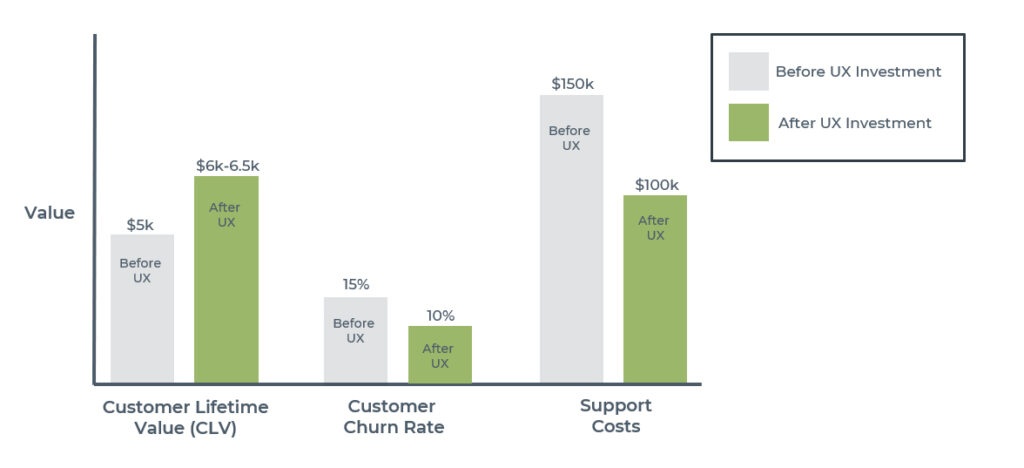
This chart illustrates the measurable impact of a strategic UX investment, showing improvements in key business metrics like Customer Lifetime Value, Churn Rate, and Support Costs.
A strategic approach to user experience design services is built on this very principle. A professional team understands that design is not just about making a product look good; it’s about making it work well—for the user and for the business. By understanding the data and focusing on the metrics that matter, a company can deliver strategic UX that drives tangible ROI and provides a significant competitive advantage.
About The Author
Eve Gravely is a Marketing Manager at Cardinal Peak, a product engineering services firm with the backing of its parent company, FPT. With a background in marketing and communications that spans over two decades, she specializes in developing data-driven content strategies that drive business growth for technical firms. Her expertise lies in building compelling narratives around complex technologies, from embedded software to user experience (UX) design.

At Cardinal Peak, she focuses on creating educational, value-add content that appeals to a highly discerning B2B audience, including VPs of Engineering and Product Managers. Her work is centered on leveraging search engine optimization (SEO) and lead generation tactics to connect businesses with the right engineering partners. She is passionate about translating technical expertise into clear, impactful stories that resonate with a professional audience. You can learn more about her work at cardinalpeak.com.
Key questions
How do you calculate the ROI of a UX design investment?
Align UX goals with business metrics, establish pre-design baselines for conversion rates or support costs, then quantify improvements after launch — for example, a 3% conversion increase or 20% fewer support tickets — and assign each a dollar value.
What business metrics does UX design actually affect?
UX investment can improve conversion rates, reduce customer support costs, increase customer lifetime value through better retention, and shorten development cycles by reducing costly rework.
Why do executives struggle to approve UX design budgets?
UX is often perceived as a ‘nice-to-have’ aesthetic expense rather than a measurable business driver, so the case must shift from discussing design quality to quantifiable revenue gains and cost savings.