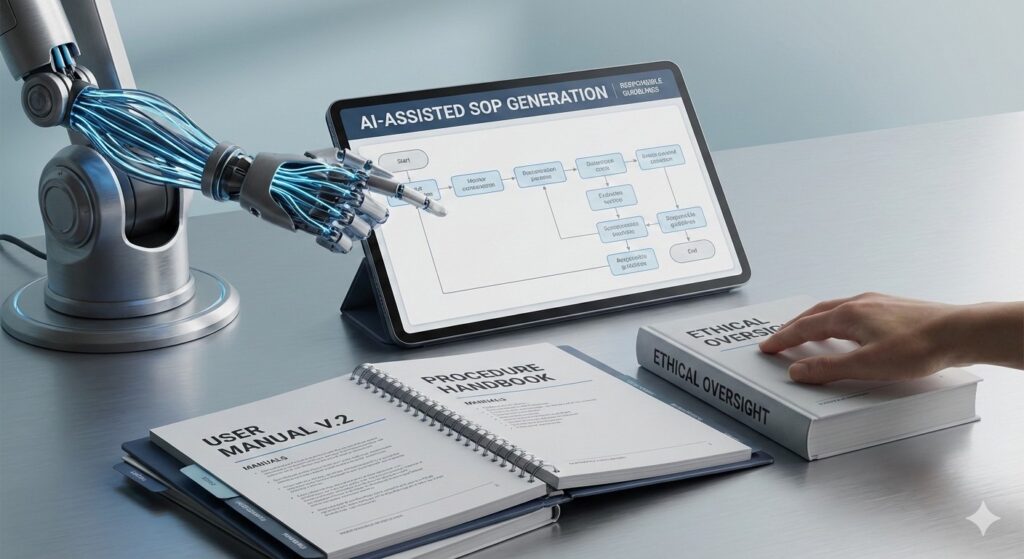
Slowing Down to Get It Right: Using AI to Create SOPs and User Manuals Responsibly
By Chris Hutchins, Founder & CEO – Hutchins Data Strategy Consultants
Artificial intelligence has made it easier than ever to generate documentation. Standard operation procedures, internal playbooks, and user manuals that once took weeks to assemble can now be drafted in minutes. That kind of efficiency is appealing, especially for smaller teams and leaders under pressure to move faster.
But speed is also where the risk begins.
AI is exceptionally good at producing something that looks complete. It fills gaps confidently, borrows patterns from past material, and assembles language that sounds right, even when it has not been verified or made safe for your organization. When it comes to SOPs and user manuals, which are documents that shape behavior and guide decisions and can contain sensitive operational detail, caution is not optional. It is the most important part.
The goal is not to avoid AI. The goal is to slow down long enough to use it well.
Start with what you actually need, not what AI can generate
One of the most common mistakes organizations make is starting with the tool instead of the problem. AI can generate SOPs for almost anything, but that does not mean everything needs to be documented, or documented right now.
Before involving AI, leaders should step back and ask a few basic questions: What processes actually need standardization? Where do mistakes or inconsistencies occur? What knowledge currently lives only in people’s heads?
AI works more efficiently when there is a clear structure and appropriate context in place. Simply dumping all the documents and information you have creates confusion instead of clarity.
Intention is the keyword here. It’s intentional prompt engineering; providing the tool with existing frameworks that have worked and workflows that currently make sense will grant you a better output; including real examples that actually work for you. All this, within the right framework, can provide you with automations that work for you.
Instead of giving AI all the credit as the author, think of it more as an organizer — someone who has access to all the information and goes back years and helps you anticipate your needs now. But again, don’t be too trusting; AI still needs directions. Without it, you risk codifying assumptions instead of reality.
Be careful with what you provide the AI, and where you provide it
Not all AI environments are created equal. Browser-based tools operate outside your firewall. That means anything entered into them may leave your control, even if it feels harmless at the moment.
This matters more than most people realize. SOPs and user manuals often include details about systems, access points, internal controls, escalation paths, or proprietary workflows. On their own, those pieces may seem insignificant. Combined, they can create a complete operational picture you never intended to share.
Organizations should assume that employees are already experimenting with AI, whether policies exist or not. That is why governance needs to come before broad adoption. Clear guidelines about what can and cannot be entered into AI tools are critical. Especially in HR, operations, legal, and healthcare environments.
When using AI to generate internal documentation, it should ideally be done within controlled systems, using private models or environments designed to protect sensitive information.
Convenience should never outweigh containment.
Proofread everything
AI has many strengths. Judgment is not one of them.
Even when you use your material for training, AI can contradict instructions, reuse forbidden language, or confidently assess something that is subtly wrong. Anyone who has told a model not to use a specific term, only to see it appear in the very next paragraph, has experienced this firsthand.
The analogy that often comes to mind is an impulsive child: capable, fast, occasionally brilliant, and still in need of supervision.
This is where human responsibility remains non-negotiable. Every SOP and user manual generated with AI must be reviewed line by line. Not skimmed. Not assumed to be correct because it “sounds right.” These documents guide real people doing real work. Errors do not just create confusion; they create risk.
Proofreading is not a lack of trust in technology. It is acknowledging that automation without oversight has consequences.
Transparency matters, but policy comes first
For internal communications, transparency doesn’t have to be a big deal. Employees do not require disclaimers on every page. However, they do deserve clarity about expectations. Again, it needs to be assumed that people are using it. So, it’s best to provide the proper guidelines.
Before announcing that AI was used to create SOPs or manuals, organizations should ensure they have already defined how employees are allowed to use it. Without that foundation, transparency can unintentionally open the door to misuse — especially when people assume that if leadership is using AI, anything goes.
The bigger issue is not whether AI was used. It is whether its use is governed. Clear policies, shared understanding, and reasonable guardrails do far more to protect organizations than silence or overexposure.
Moving forward with intentional caution
AI can be an extraordinary accelerator for documentation. It can help organizations capture institutional knowledge, standardize processes, and reduce the burden on already stretched teams. When used with thoughtful intention, it turns vague instructions into usable systems.
But this is not a space for blind trust or unchecked speed.
The organizations that will benefit from AI are not the ones racing to automate everything. They are the ones willing to pause, define their needs, protect their information, and scrutinize the output before putting it into practice.
Caution does not mean resistance. It means respect. Respect for the complexity of your organizations, respect for the people who rely on these documents, and respect for technology itself no matter how advanced will always reflect the flaws of the humans who built it.
In a moment when everything feels like it is moving too fast. Slowing down may be the most strategic decision you can make.
Chris Hutchins serves as the founder and CEO of Hutchins Data Strategy Consulting. The healthcare institutions benefit from his expertise in developing scalable moral data and artificial intelligence methods to maximize their data potential. His areas of expertise include enterprise data governance, responsible AI adoption, and self-service analytics. His expertise helps organizations achieve substantial results through technology implementation. Through team empowerment, Chris assists healthcare leaders enhance care delivery while reducing administrative work and transforming data into meaningful outcomes.