Rethinking Data Storage in the Age of Millions of HDDs Shredded
By Martin Kunze, co-founder and CMO, Cerabyte
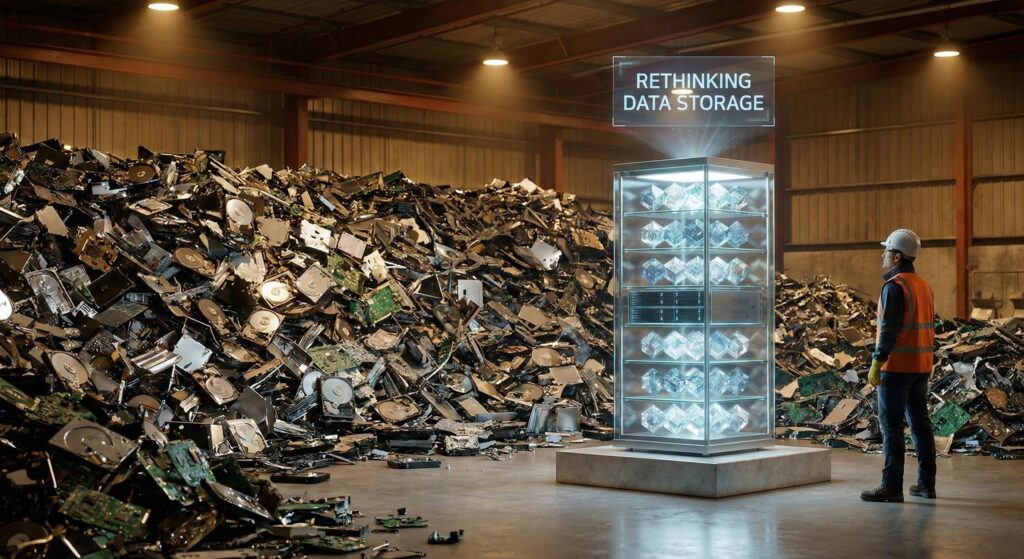
An increasingly urgent challenge facing data centers is the staggering volume of hard drives reaching end-of-life.
While headlines highlight increasing AI investments and rapidly advancing GPUs, most coverage of the downsides mainly focuses on energy use and waste-heat reuse. Almost no one talks about the other elephant in the server room: storage media simply don’t last as long as the data we keep. Much of what enterprises store must persist for decades—far longer than the five- to ten-year lifespan of the media that hold it.
In practice, this involves ongoing data migration. Every 5–10 years, data needs to be transferred to new HDDs, SSDs, or tapes, and the old media decommissioned. Some are resold after data sanitization, while others are incinerated or shredded. Ideally, electronic waste is separated and recycled. There are no definitive public statistics on annual disposals across all media types. But a simple look at historical shipments is sobering. Assume an average seven-year service life: the HDDs shipped in 2018 are now aging out. With roughly 375 million HDDs shipped that year, that’s on the order of one million drives hitting end-of-life every day.
Even though annual HDD unit shipments have fallen since their 2010 peak (~650 million), per-drive capacity has climbed, especially for data center and enterprise applications – so the industry has shipped more EB with fewer hard disk drives. This trend is likely to continue as HDD areal density continues to grow. However, the number of HDDs shipped for data center applications will continue to grow, due to storage demand. From 2019 through 2024, about 1.2 billion HDDs were shipped, which eventually need to be replaced.
Analysts expect the volume of stored data to grow by more than 5× per decade. Much of this data will likely be stored on HDDs in data centers. HDD unit shipments for data center and enterprise applications in 2024 are estimated to be about 5.6% higher than in 2023 and could be about 27% greater by 2030. This growth will increase the number of HDDs that will eventually need to be replaced.
Today’s storage technologies were engineered first for compute performance, not for century-scale preservation. That mismatch is becoming a sustainability problem as datasets swell. Beyond the physical waste and materials intensity of device manufacturing, there’s the energy cost of simply keeping data alive: data only survives over time when the power stays on.
Data migration and maintenance are becoming a significant data-center workload because throughput isn’t scaling anywhere near as fast as data volumes (which must eventually be moved). As a result, the balance of data use could shift: more time and energy may go to keeping data alive and less to productive computing – an inevitable and worsening trade-off.
Extending device lifecycles helps – but only delays the inevitable. And large-scale “delete by policy” is unlikely. Data is too valuable today, and AI only increases the incentive to retain it in hopes of extracting future insights.
For the foreseeable future, hard drives will continue to serve capacity storage needs in data centers. Demand for performant, economical capacity will keep rising. But if we keep solving all long-term data retention with short-lived media, the refresh treadmill – and its environmental and operational costs – will keep accelerating.
AI amplifies this further: it generates vast new datasets and compels retention of model outputs, training artifacts, and decision audit trails. Early market signals — such as lengthening lead times and upbeat moves in storage vendors’ order books and stock prices — point to an even faster ramp-up ahead. Emerging approaches aim to break the trade-off between long-term durability and practical access. For example, technologies that target virtually indefinite retention with seconds-scale latency and high-bandwidth retrieval, bringing archival-class longevity closer to online usability. Crucially, the media is using basic materials, such as sand, and a comparatively simple process, yielding a smaller carbon footprint than other media technologies that require higher-grade materials and significantly more complex processes. The separation of media from write/read electronics (at the cost of latency) is a further step towards a deployment adaptable to the service-level requirements of a wide range of use cases, all the way to a stack of media in the form of a time capsule.
This isn’t tomorrow-morning deployment; scaling any new medium to data-center volumes takes time. But the direction is clear: to make data retention sustainable amid exponential growth, we need media designed for longevity first, without sacrificing practical access.
Technologies with long-term media lifecycles are now being developed and must be pursued and scaled. Historically, storage has been viewed as less compelling for venture investment compared to compute or AI in terms of perceived value creation. That dynamic is changing. Closing the storage sustainability gap will require not only technical imagination across the industry, but also visionary investors willing to back platforms that deliver orders-of-magnitude improvements in lifespan, manufacturability, and total cost of ownership.
If we want AI’s promise without drowning in our own data exhaust, we must rethink how we store information for the long haul. One million drives a day is a stark metric. It should also be a rallying cry.
Martin Kunze, founder and CMO, Cerabyte
Martin Kunze is co-founder and Chief Marketing Officer of Cerabyte. Drawing on his background in ceramics and design, Kunze conceived the core idea to use hardened ceramic materials as a durable medium for digital information – a vision influenced by his earlier initiative, Memory of Mankind (MoM), which he founded to archive a snapshot of our era in imperishable physical form. At Cerabyte, Kunze helped translate that vision into a viable commercial venture: under his marketing leadership, the company secured seed funding, forged strategic partnerships (including collaboration with CERN OpenLab), and developed an end-to-end prototype demonstrating ceramic data storage with sustainable, energy-free preservation for decades or even centuries.