Scaling Smart: Strengthen Systems Before Expanding
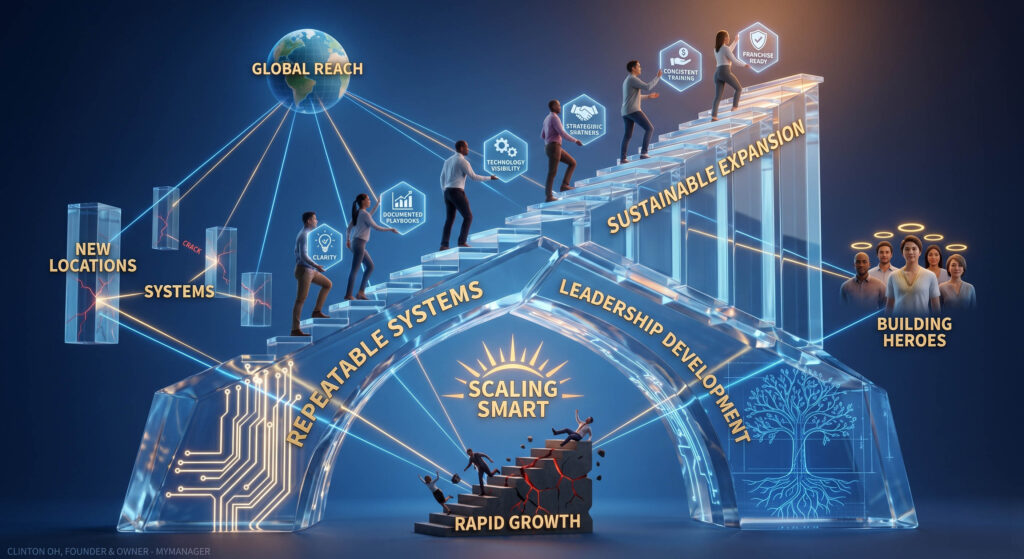
By Clinton Oh, Founder & Owner — MyManager
If you’re familiar with that twinge of envy you feel when you see yet another startup burst onto the scene, then many founders would agree. Rapid growth always looks exciting from the outside, but that’s not the whole picture. Growth is a stress test.
On the outside, people see new customers and new locations. On the inside, all the tiny cracks that were easy to ignore when you were small grow quickly wider. Processes suddenly feel unclear, and existing technology can’t support the new demands. Training is inconsistent or reactive, and leaders feel stretched.
Unless you take the time to put a structure in place, expansion will drain your best people and can even undo your early wins.
Operational missteps businesses make when scaling
One operational mistake I see far too often is scaling without repeatable systems. Many founders are able to drive results through energy and instinct. Unfortunately, that approach doesn’t scale.
If quality depends on the founder being in the room, growth can only take a company so far. A growing company needs to succeed even when the founder isn’t present. It needs clear systems and standards that anyone can follow.
Another mistake is forgetting that your role must change as you grow. As the founder, you shift from an operator to a developer of people. The new work is to build leaders who can run the business with you. Before you expand, training and leadership development must be in place.
A final mistake is pushing for expansion before everyone sees eye to eye. The right partners and leaders are essential. You’ll find that a misaligned manager won’t do much to protect the brand you worked so hard to build. Fast growth without the right people adds risk and makes it incredibly harder to fix problems later.
Why growth exposes weak systems and leadership gaps
In a small startup, much of the knowledge lives in the founder’s head. You know exactly how to handle a tricky customer or a late shipment.
But that’s not enough when you scale. When you can’t be everywhere at once, you must turn that mental information into playbooks and training. It’s the only way other people can deliver the same standard every day.
Documentation makes this happen. Before you expand, write down precisely how you run operations, training, marketing, onboarding, and customer experience.
Make the steps easy to find and easy to teach. If your methods live only in emails or private notes, cracks will show as soon as you expand. Teams will guess, and quality will drift.
Good technology helps you measure these processes as you grow by giving you visibility into every aspect of the business. You take it slowly and fix what needs fixing. In addition, platforms can keep your communications consistent across teams.
But when you scale without the right tech in place, things go wrong quickly. Your tools won’t connect, and your data gets siloed. Reports run late, and managers spend hours stitching together spreadsheets. The overall result is a drop in productivity and rising burnout.
And if you attempt to grow without first putting leaders in place, gaps make themselves known fast. Managing one team is nothing like leading many, and effort alone doesn’t scale. Without developing leaders to share the role, your results will swing, and you’ll see mounting frustration on the front lines.
How founders can prepare their infrastructure before expanding
Learn to take your growth in phases. That’s the only way to maintain control without killing momentum.
First, you have to build the foundation. In other words, clarify your mission. Make sure everyone knows what great looks like and what you will never trade for speed.
Then, turn all the processes you’ve designed in your head into standard procedures and set up checklists for daily work. Build onboarding that gets your new hires off to a good start and create service standards for tough issues.
The secret is that these systems don’t control people. They give people clarity so they can perform at a high level.
Next, expand in a controlled way. Treat the first stage of explanation as a pilot and run the documented processes exactly as written. Measure results, and fix what breaks. Instead of adding more locations than your support team can handle, set a pace that protects what you’ve built.
Last but not least, scale through leadership by developing managers who build other leaders. Your job is no longer to be the hero. You are now the one who builds heroes. Develop leaders who embody the mission and model it for others. Choose your partners with care, especially in franchising. Pick values and coachability over speed and cash.
You’ll know when you’re ready to grow. Hold off on expansion if your methods still live in your head, and workarounds hold your tools together. Slow down if you’re in firefighting mode most days, and your best people feel tired and close to leaving.
You’re only ready to scale when your new hires get the training they need and when you can see the business in real time, even when you’re not around. You’re ready when quality holds and when managers improve results thanks to the data and coaching systems you deploy.
Long-term companies accept that scale adds risk and answer that risk with preparation. They build systems to clarify and technology to connect. Most importantly, though, they build leaders who lift others. Build the foundation, then let your systems carry the weight.

Clinton Oh is a serial entrepreneur, growth architect, and consultant. He is the Founder of Next Level Media and MyManager, a company that allows entrepreneurs to better manage operations through a streamlined automation platform. The son of a martial artist, Clinton began his career by turning his family business into a nationwide franchise and has since become the franchisor of multiple brands. As a consultant, Clinton is known for streamlining processes and preparing brands to franchise. With over 100 partnerships and multiple successful exits, he is committed to empowering entrepreneurs and building businesses for sustainability and longevity.