The Post-Click Gap: How the Best AI Tool for Phishing Triage Track Follow-on Activity
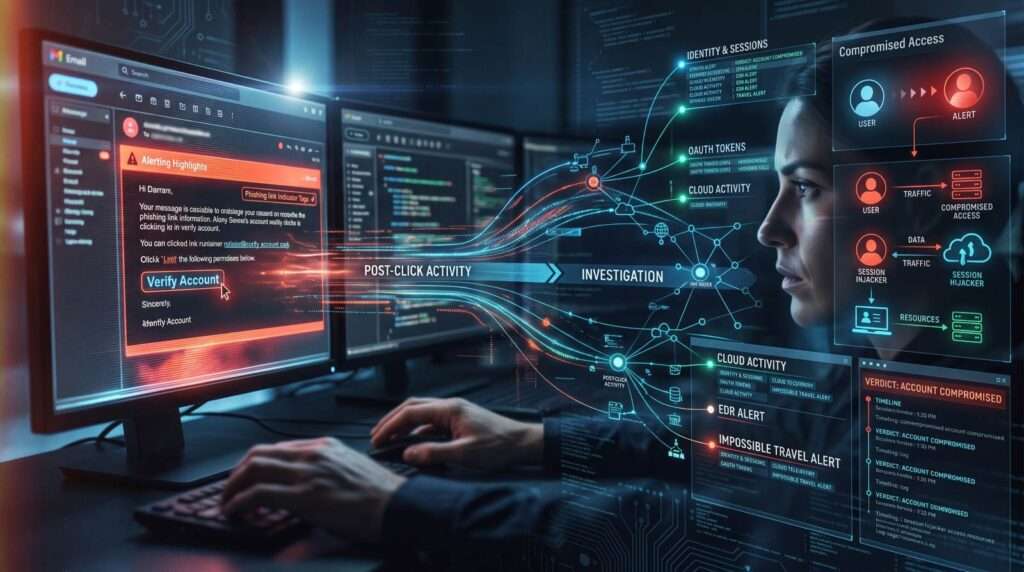
Search for the best AI tool for phishing triage, and most comparisons will tell you how well a product spots a malicious email. That is useful, but it does not tell you what happens when someone clicks one. The hard part of investigating phishing alerts is understanding whether the recipient of the phishing email interacted with the email and to what extent.
A thorough phishing triage and investigation covers the email itself and the activity that can follow it. Before a click, the job is to identify a malicious message and stop it from reaching the user. If it gets through, the SOC needs to find out whether the user handed an attacker credentials or a session they could use.
Some controls sit between the two. A URL protection service might re-scan a link when the user clicks it, for example. But once an attacker has usable access, investigating the compromise requires evidence outside the email.
Most phishing tool comparisons concentrate on the earlier part of that process.
Catch Rate Stops at the Email
Catch rate is useful for measuring email security. Did the gateway block the message? Did the filter identify it correctly? How many malicious emails reached an inbox?
It becomes less useful once it is treated as a measure of the phishing risk as a whole.
The FBI received 191,561 phishing and spoofing complaints in 2025, compared with 193,407 in 2024. Yet reported losses rose from around $70 million to $215.8 million. Complaint volume barely changed while reported losses more than tripled.
Verizon’s 2026 Data Breach Investigations Report found that the human element was involved in 62% of breaches. Phishing remained an initial access vector in 16%.
Those figures put more weight on what happens when preventive controls fail. Once a phishing email gets through, the analyst needs to establish what the user did next and whether the attacker was able to turn that interaction into access.
Prophet Security, a leading AI SOC platform, correlates identity, cloud, and email telemetry into a single verdict on whether a click became a compromise. Its own quarterly investigation data found that identity was the target in 46% of confirmed malicious activity. Credential phishing made up about 28%, with another 18% involving attacks on accounts and sessions, including session hijacking and token replay.
Post-click Triage Needs Different Evidence
An AI system can inspect an email’s sender, headers, URLs, attachments, and language and decide that the message is malicious.
That verdict does not establish whether the attack worked.
If a user followed a credential-harvesting link, the analyst needs to know whether the credentials were later used to sign in. A stolen session is harder to spot, since the attacker may not need to log in at all. The same quarterly data found inbox-rule changes at nearly as many organizations as impossible travel alerts, and both stolen sessions and hidden inbox rules survived a password reset.
Prophet Security’s phishing investigation guide follows MITRE ATT&CK in treating phishing as a delivery mechanism, with the investigation continuing through user interaction to any resulting compromise. The Prophet AI SOC Platform goes so far as to ask the end user whether they interacted with the email as soon as the alert investigation begins, ensuring they get all the evidence.
This is where conventional phishing triage can run out of road. Faster email classification helps the analyst deal with the message, but establishing whether an account has been compromised requires the investigation to follow activity beyond the inbox.
What to Ask When Evaluating a Triage Tool
Check whether the tool can see identity and session telemetry, rather than email data alone. Access to that data is only part of the test. If credentials were harvested, the tool should be able to establish whether they were later used. If a malware was installed, it should reach EDR telemetry and correlate any EDR alerts as part of the same campaign, according to Prophet Security.
If an attacker obtained an authenticated session, it should be able to connect subsequent activity back to the phishing event.
The timing metric is important, too. A product might classify an email in seconds or save an analyst several minutes of manual review. That measures how quickly it reaches a verdict on the message. The account could still be compromised while the investigation is considered complete.
For post-click triage, measure elapsed time from the click to a validated verdict on account compromise.
Look Past the AI Label
Security platforms are also adding broader AI-assisted and agentic capabilities, which makes labels such as “AI phishing triage” less useful on their own.
Microsoft Security Copilot now includes autonomous agents for phishing triage and broader alert investigation across Defender and Sentinel telemetry. CrowdStrike has expanded Charlotte AI into agentic investigation and response within Falcon. Neither product’s presence in a phishing-tool comparison, however, tells you whether the specific workflow being evaluated will correlate a successful phish with the identity and session activity that follows it.
A behavioral-baseline inbox tool may identify an unusual sender or suspicious message. A broader SOC platform may also have access to identity data. What matters in a post-click investigation is whether the tool can follow the evidence far enough to establish if the attacker got in.
That capability often falls outside conventional email-security comparisons, which helps explain why catch-rate rankings provide an incomplete picture for SOC teams choosing a phishing-triage tool.
At the next vendor demo, ask to see what happens after a user clicks. Have the vendor follow the investigation into the identity environment and show whether the tool can establish if the attacker obtained access. Now, measure how long that takes.

Kirsten Doyle has been in the technology journalism and editing space for nearly 24 years, during which time she has developed a great love for all aspects of technology, as well as words themselves. Her experience spans B2B tech, with a lot of focus on cybersecurity, cloud, enterprise, digital transformation, and data centre.
Her specialties are in news, thought leadership, features, white papers, and PR writing, and she is an experienced editor for both print and online publications. She is also a regular writer at Bora.