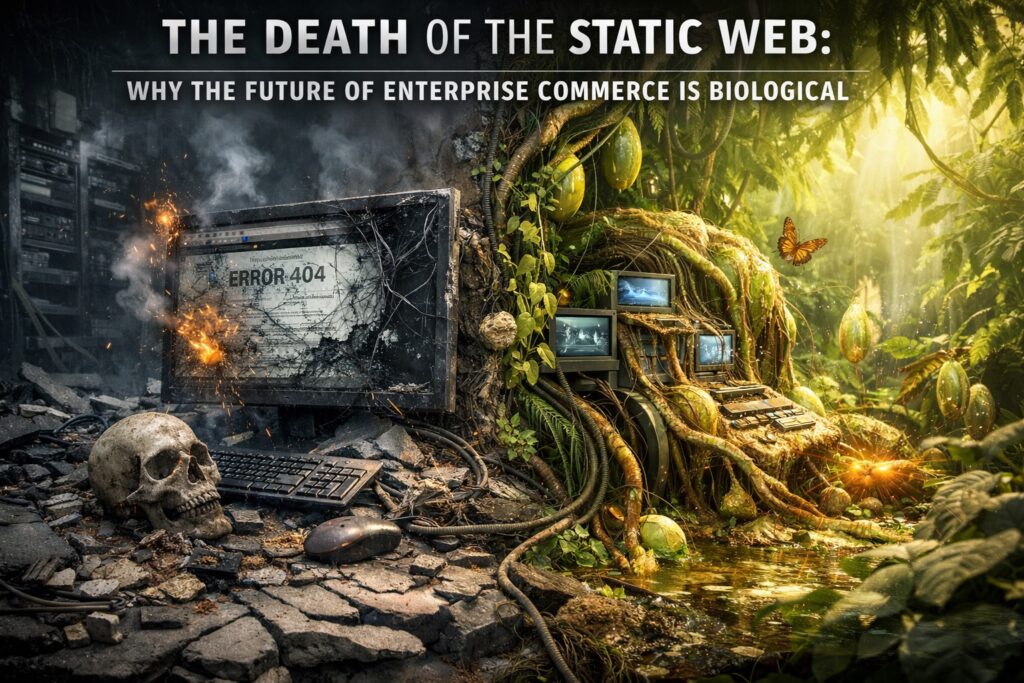
The Death of the Static Web: Why the Future of Enterprise Commerce is Biological
By Cameron Batt
For the past twenty years, the internet has been built on a metaphor of architecture. We “build” websites. We “construct” pages. We lay “foundations and groundwork.”
This language implies something static and brittle. A building, once finished, doesn’t change. If a window breaks, it stays broken until a human fixes it. If the weather changes, the building doesn’t adapt to the new environment.
This architectural metaphor is becoming a liability in the customer funnel. In the high-velocity world of modern commerce, where user behavior shifts in milliseconds and algorithmic updates can break revenue streams overnight, a static website is a business risk.
Thanks to advancements in agentic computing, we’re seeing a fundamental shift in how digital experiences are managed. We are moving from Architectural thinking to Biological thinking.
The next generation of enterprise infrastructure won’t be “managed” by humans, it will be “healed” by agents and rendered dynamically depending on the predictive variables which the platforms has pre-digested and been trained on.
The “Immune System” for E-Commerce
Consider the human immune system. It operates autonomously. You don’t consciously tell your white blood cells to attack a virus, they detect the anomaly and deploy a response instantly. If you imagine this from a retail perspective… you walk into Walmart and can’t find what you’re looking for, the staff are busy so you walk out. Fast forward to an agentic approach, the cameras in the store identify that you’re intent isn’t being facilitated, so signage pops up directing you to the correct aisle and even product. Of course this is a real-world example, but imagine it from a digital perspective.
Digital commerce needs this same capability.
Currently, if a checkout button fails on a specific device configuration; say, an iPhone 16 running a specific version of Safari, the error persists until a customer complains, a support ticket is filed, a product manager prioritizes it, and an engineer deploys a hotfix.
This “Time-to-Insight” gap can last days, especially when UX teams don’t understand the resource and capabilities of the tech team. This antiquated delivery of design changes means bleeding revenue every hour.
In a biological model, Autonomous AI Agents act as the immune system. These agents, synthetic users powered by Large Language Models (LLMs) and commercial computing power, continuously “patrol” the digital ecosystem. They simulate thousands of user journeys 24/7, clicking buttons, filling forms, and verifying visual integrity.
When an agent detects friction. Let’s say a “virus”. It doesn’t just log a ticket. It characterizes the issue and, via integration with Edge computing networks, can deploy a remediation patch instantly. The site heals itself.
From A/B Testing to Contextual Evolution
This biological shift also applies to commercial growth.
Traditional Conversion Rate Optimization (CRO) relies on A/B testing, which by nature is a slow, rigid process where we test one static idea against another. It is the equivalent of natural selection, but played out over months (requiring costly human intervention at every stage).
The future is Contextual Bandits, algorithms that learn and adapt in real-time. Instead of serving a static page, the infrastructure serves a probabilistic experience.
If a user exhibits “high intent” signals (fast scrolling, price checking), the system adapts, stripping away distractions and simplifying the path to purchase. If a user exhibits “discovery” signals, the system expands, offering richer content and video.
This is Liquid Commerce. The interface isn’t a fixed document, it is a fluid response to user intent.
The Role of the Human Architect
Does this mean the end of the human designer or marketer? No. It means the elevation of their role.
In a biological system, humans are no longer the “Janitors” of the website, manually fixing links and resizing images. They become the Architects of the DNA.
Human teams will define the guardrails, meaning the brand aesthetics, tone of voice and ethical boundaries. The AI agents then execute within those bounds. This concept, known as Visual Governance, allows enterprises to scale optimization infinitely without ever “breaking the brand.”
The era of the static website is closing. The complexity of the modern web, with its infinite fragmentation of devices, browsers, and user behaviors has surpassed the ability of manual teams to manage it.
The winners of the next decade will be the organizations that treat their digital presence not as a building to be maintained, but as a living organism that evolves, adapts, and heals itself.
About the Author

Cameron Batt is a Machine Learning Researcher and Technologist based in London. He is the Founder of Skubl, an autonomous customer experience platform that uses AI agents to detect and repair revenue friction. Previously a Performance Director at global agencies like Wavemaker, Cameron’s peer-reviewed research on Causal Inference and Multi-Armed Bandits focuses on bridging the gap between deep-tech research and scalable commercial infrastructure.