The Forgotten Frontline: Are Incomplete UC Deployments Causing Avoidable Risk?
By Nick Muir is General Manager for EMEA at Spectralink.

In the wake of the COVID-19 pandemic, most large organisations deployed modern unified communications (UC) platforms, for instance Microsoft Teams, to connect and empower employees in any location. Yet when organisations calculate the benefits of those deployments, they look predominantly at knowledge/office workers who ordinarily spend their time at a keyboard or in meetings. This does not include the 80% of the global workforce operating at the frontline. Key workers such as nurses, factory workers, retail associates and facilities staff, who rarely sit at desks.
This leaves a lot of critical people uncatered for. In the U.K., France, and Germany combined, healthcare employs more than 9 million workers, manufacturing accounts for over 12 million, and retail represents a further 12 million. These are sectors with significant volumes of people working in frontline roles. But, actually, very few industries operate without at least some reliance on “untethered” workers. Research from Cavell estimates that 81% of organizations employ location-specific frontline workers — defined as those who work with customers or operations yet are mobile within a primary location.
Too often, where the formal office ends, so too does the fully connected experience — particularly when workers enter rugged environments or areas with unreliable connectivity. This is not only a matter of connectivity, but also of device suitability. Standard desktop or mobile clients are generally inadequate for environments in which noise, hygiene protocols, ruggedisation requirements and safety regulations feature strongly; and where maintaining reliable voice communications is a big part of the challenge.
Industries with particular exposure
In healthcare, devices must withstand rigorous disinfection protocols between shifts. Communications coverage must remain reliable throughout complex building structures, including basements and reinforced areas that may have poor wireless connectivity. Integration with nurse call systems, patient monitoring platforms, and electronic health records is essential for clinical workflows. If broadband networks are knocked out, connections drop, or devices aren’t fit for purpose, the entire care delivery model could be at risk.
Manufacturing environments require continuous coordination whatever the noise levels, for both operational efficiency and safety. Communications must integrate with production and inventory systems. Mandatory worker safety features, such as panic alarms and motion sensors, become non-negotiable in hazardous environments.
Retail operations require customer-facing staff to access inventory information, pricing details and product specifications in real time. When frontline communication devices are integrated with inventory management systems, associates can verify stock availability across locations without abandoning customers. In many smaller retail environments, employees are still often bound to a single landline; if they step away, calls go unanswered.
Failover concerns
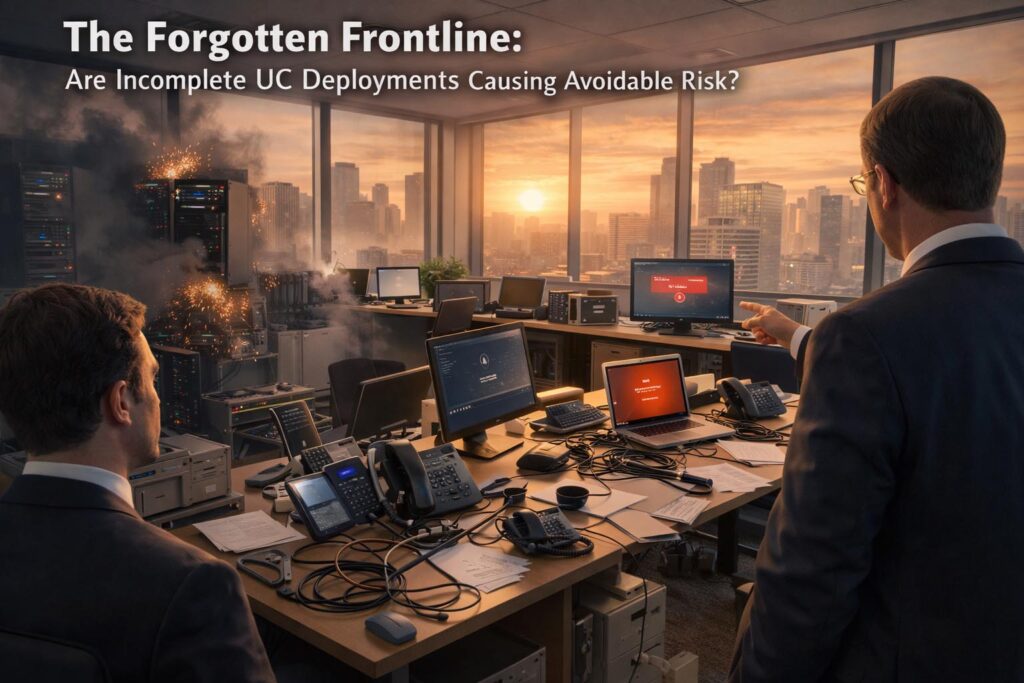
When organisations invest heavily in cloud-based UC platforms, they assume that one of the benefits is that communication capabilities will remain available when needed. But when broadband outages occur, standard UC deployments become unusable. For frontline staff in safety-critical environments, this represents genuine risk.
Technologies including DECT (Digital Enhanced Cordless Telecommunications) are a viable option here, creating dedicated communication channels that persist irrespective of Wi-Fi or LAN status, while still enabling peer-to-peer calling and full UC platform integration during normal operations. DECT systems are inherently more difficult to compromise than Wi-Fi or cellular networks, too. This is because they operate on dedicated frequencies with their own authentication protocols. In an era of increasing cyber threats to critical infrastructure, this architectural separation offers an important additional security layer.
Compliance expectations
For employers, the risks around untethered employee provisions are amplified by worker safety regulations. Europe is highly prescriptive in its lone worker regulations, emphasising specific risk assessments, active supervision and emergency procedures.
In the U.K., Martyn’s Law (a response to the Manchester Arena terror attack in 2017), has been in force since July 2025, requiring public venues and events hosting more than 250 people to implement verifiable emergency alert protocols. In the U.S., Kari’s Law mandates that notifications are routed simultaneously to internal security and emergency services, while RAY BAUM’s Act requires dispatchable location information, including specific room and floor data,.
Closing the gaps
In 2026, critical frontline workers should be central to any pending digital transformation plans. Successful and reliable extension of UC capabilities requires native integration with collaboration platforms. It means maintaining single identity and presence across all employee types, enabling seamless messaging regardless of device or location and ensuring consistent administration.
The following five steps can help focus investment appropriately:
- Analyse the actual operational requirements
- Evaluate infrastructure honestly
- Prioritise interoperability over uniformity
- Calculate ROI using more than productivity metrics
- Build for resilience, not just capability.
Nick Muiris General Manager for EMEA at Spectralink.