The Great AI Divide: Why Infrastructure Maturity Determines Who Scales and Who Stalls
By Jay Subramanian, SVP & GM of Core Storage Platforms, Hitachi Vantara
AI adoption is now nearly universal. But as organizations push AI deeper into the business, the real differentiator is no longer ambition. It is whether the underlying data infrastructure can support AI at scale. According to Hitachi Vantara’s State of Data Infrastructure Report, 98% of organizations are using, piloting or exploring AI. Across the United States and Canada, enterprises are investing heavily to integrate AI into business operations, products and decision-making.
Yet widespread adoption has not translated into widespread success. The same research shows that more than half of organizations in the U.S. and Canada are struggling to realize value from AI, contributing to tens of billions in wasted AI investment globally each year. As AI moves from experimentation to execution, long-standing weaknesses in data infrastructure are becoming harder to ignore.
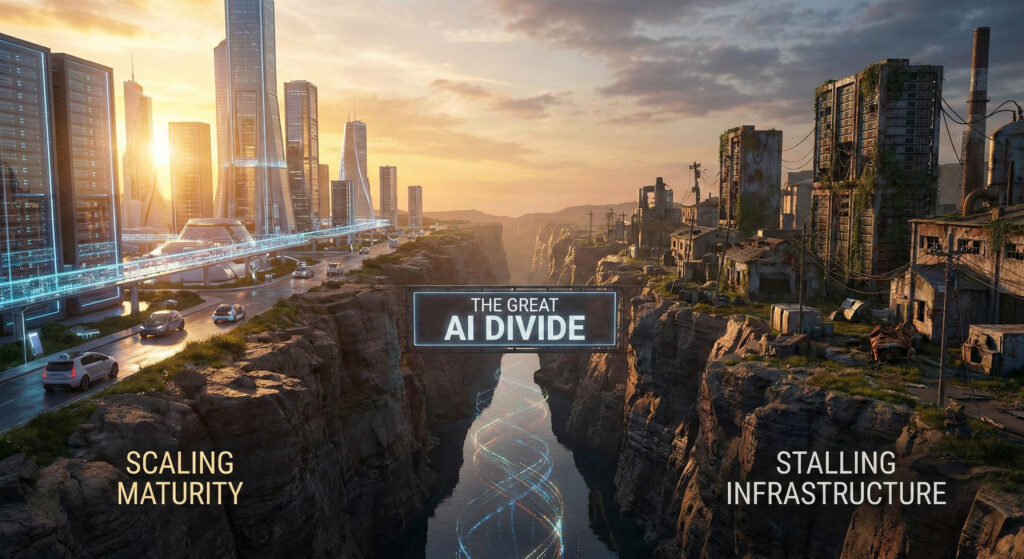
This is the Great AI Divide: the gap between organizations that can scale AI with confidence and those that remain constrained by their legacy data foundations.
That divide has nothing to do with how organizations are using AI, how much they’re spending on it or how large the company is. It is about whether their data infrastructure is ready to support AI at scale and has leadership support.
The cost of data immaturity is already visible
In the U.S. and Canada, 58% of organizations fall into defined, emerging or fragmented stages of data maturity, meaning their data environments lack the structure, automation, or consistency required to support AI at scale. By contrast, 42% are considered data-mature, which means they have optimized data practices.
The differences between the two groups are dramatic. Among data-mature organizations, 84% report achieving measurable return on AI investments, compared with just 48% of data laggards.
Data complexity plays a central role. The report found that 84% of U.S. and Canadian organizations say data complexity is rising rapidly or too quickly to manage, driven by growth in data volumes, platforms and AI itself. As environments become more complex, organizations struggle to maintain visibility, control and accountability across their systems.
These challenges translate directly into risk. Fifty-seven percent of leaders say data complexity makes it harder to identify a data breach, 59% fear a critical data loss would be catastrophic and half say their systems are complex enough that executives would lose sleep if they fully understood the risks. That is not a theoretical problem, it is an operational one.
This difference underscores a clear reality: AI success is far more closely tied to data readiness than to enthusiasm or spend.
What infrastructure maturity really means
Closing the Great AI Divide requires more than incremental improvement. It requires a shift in how organizations think about their data infrastructure.
Mature organizations distinguish themselves through disciplined data management, automation and resilience. According to the report, 65% of data-mature organizations have automated infrastructure operations, compared with just 27% of organizations with weaker data practices. Automation reduces operational friction and enables AI systems to scale without overwhelming IT teams.
Leadership alignment also matters. Among data-mature organizations, 87% report having a strong leadership vision, allowing data and AI initiatives to be treated as strategic priorities rather than siloed IT projects and enabling faster decision-making when tradeoffs arise. That alignment helps ensure AI efforts stay focused on the right use cases, with clear ownership and accountability for outcomes. And it matters, because the report shows that 96% of organizations say they need outside help with data infrastructure, but many still struggle to translate that need into coordinated action.
Security and resilience are now foundational
As AI adoption accelerates, governance and security concerns are intensifying. The report shows that only 43% of U.S. and Canadian organizations have predictive or automated infrastructure operations, limiting their ability to maintain visibility and control as complexity grows. AI does not just increase the volume of data organizations manage. It increases the speed at which data moves, the number of systems it touches and the consequences when controls break down. In this environment, security and resilience cannot be layered on after the fact. They have to be built into the data foundation.
Resilience is another key differentiator. Eighty-two percent of data-mature organizations report having sustainable design and built-in resilience, compared with only 19% among organizations with weaker data practices. These capabilities are increasingly critical as AI workloads place new demands on infrastructure and tolerance for downtime shrinks and the blast radius for failure grows.
Organizations that treat security and resilience as afterthoughts struggle to scale AI safely. In contrast, those with mature data practices build governance into their infrastructure, enabling greater confidence as AI becomes embedded in core operations.
Bridging the divide
The Great AI Divide is real, but it is not permanent. Hitachi Vantara’s State of Data Infrastructure Report makes clear that AI succeeds when the data behind it is trusted, well-governed and resilient.
Organizations that invest in strong data foundations are far better positioned to turn AI ambition into measurable value. Those that do not risk falling further behind as complexity increases and expectations rise.
The next phase of AI will not be defined by who experiments fastest. It will be defined by who builds the infrastructure to scale with confidence.
Jay Subramanian, SVP & General Manager, Core Storage Platform

As General Manager, Jay Subramanian is responsible for the strategy, development and execution of the company’s flagship VSP product portfolio to ensure that Hitachi Vantara continues to gain market share, create and deliver products, services and solutions that meet business requirements and drive adoption with customers.
Subramanian joined Hitachi Vantara in 2024 and brings more than 25 years of experience in engineering and product management roles, managing core storage technology, software and systems development, application integration and data protection. Prior to joining Hitachi Vantara, he was Vice President of Products at Pure Storage, leading the FlashArray, FlashBlade and enterprise portfolio, and previously spent more than 17 years at NetApp, including as Vice President of Product Management for ONTAP systems and software. He has extensive experience with Purity and ONTAP, two widely deployed storage OS platforms. Prior to that, he gained experience in engineering and product management through roles at McAfee (Sniffer Network Management product line), as well as with collaboration software and data center infrastructure startups.
Jay holds a Master of Science in Electrical Engineering from The University of Texas at Arlington and an MBA from the Haas School of Business at the University of California, Berkeley, and resides in the San Francisco Bay Area.