Why Mid-Sized Enterprises Are Struggling With AI Integration and How IT Leaders Can Fix the Architecture Gap in 2026
By Palak Sheth
Mid-sized enterprises are in a strange position right now. They are no longer small enough to experiment casually with new technologies, yet they are not large enough to absorb the cost of mistakes at scale. Artificial intelligence has quickly become one of those technologies that cannot be ignored. Boards are asking about it, competitors are investing in it, and vendors are aggressively pushing AI-enabled solutions into every layer of the business stack. So what happens? Companies jump in fast. Sometimes too fast.
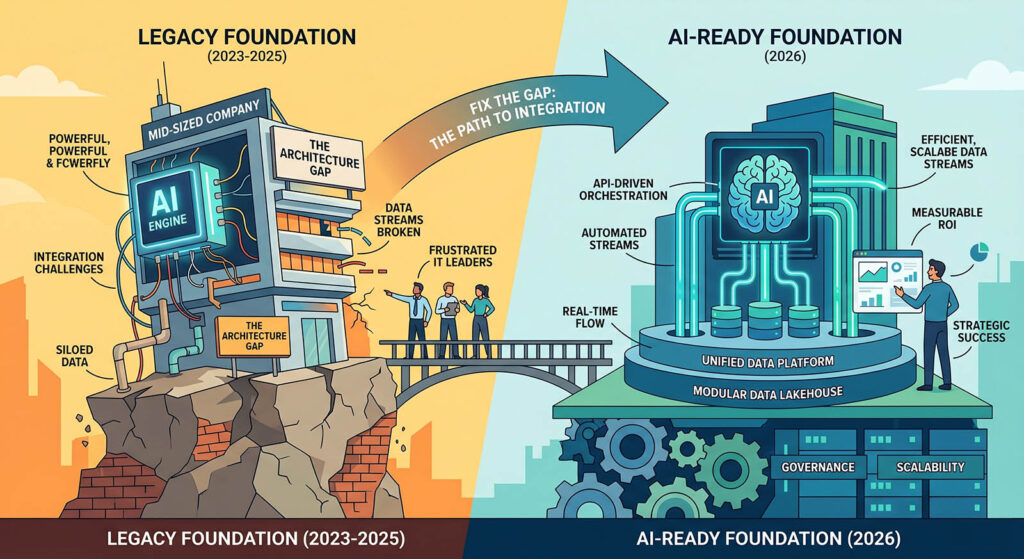
The result is what many technology leaders are now calling an architecture gap. It is not that AI tools do not work. It is that the surrounding infrastructure is not prepared to support them. Think of it like installing a high-performance engine into a car with worn-out tires and an outdated transmission. The promise is there, but the performance never materializes the way it should. This growing mismatch is quietly becoming one of the biggest barriers to meaningful AI adoption in 2026.
One of the biggest drivers behind this issue is pressure. Mid-sized organizations are under constant pressure to innovate. According to recent industry observations, a majority of mid-market firms have already piloted at least one AI initiative, yet only a small percentage report measurable ROI. That gap between experimentation and value is not caused by a lack of ambition. It is caused by structural limitations that were never designed for AI workloads in the first place.
When leadership teams decide to adopt AI, the focus is often on tools. They evaluate machine learning platforms, generative AI models, or automation software. What gets overlooked is the underlying data architecture. AI thrives on clean, accessible, and well-integrated data. Without that foundation, even the most advanced models struggle to produce reliable insights. Many mid-sized enterprises still operate on a patchwork of legacy systems, on-prem databases, and disconnected cloud applications. These environments were built over time to solve specific operational problems, not to support real-time intelligence.
This is where the architecture gap begins to show itself. Data is scattered across departments. Sales has one system, finance has another, operations has something entirely different. Each system stores data in its own format, with its own rules and limitations. When an AI model tries to pull from these sources, it encounters inconsistencies, missing context, and delays. The output becomes unreliable, which erodes trust. And once trust is lost, adoption slows down.
Another issue is integration complexity. Many mid-sized organizations rely on manual processes or basic integrations to move data between systems. These methods may have worked in the past, but they are not designed for the speed and scale that AI requires. AI systems need continuous data flow. They need to ingest, process, and learn in near real time. Without proper integration layers, this becomes nearly impossible.
It is not just about technology either. Skills play a role. Mid-sized enterprises often do not have large, specialized teams dedicated to data engineering or AI infrastructure. IT teams are already stretched thin managing day-to-day operations. Adding AI into the mix without upgrading the architecture only increases the burden. It creates friction instead of efficiency.
So what can IT leaders actually do about it? The answer is not to slow down AI adoption. That would only widen the competitive gap. Instead, the focus needs to shift toward building AI-ready infrastructure. This starts with rethinking data architecture from the ground up.
Modern data architecture is centered around accessibility and scalability. Instead of siloed systems, organizations need unified data platforms that can bring information together in a consistent format. Cloud-based data warehouses and lakehouse models are becoming increasingly popular for this reason. They allow businesses to store structured and unstructured data in one place while maintaining flexibility. This creates a strong foundation for AI models to operate effectively.
But simply centralizing data is not enough. Orchestration layers are equally important. These layers act as the connective tissue between systems, ensuring that data flows smoothly across the organization. They automate data movement, transformation, and validation. In a way, they remove the friction that slows everything down. When done correctly, orchestration allows AI systems to access the right data at the right time without manual intervention.
API-driven architecture is another critical piece of the puzzle. APIs enable systems to communicate with each other in a standardized way. This reduces dependency on custom integrations and makes it easier to scale. For mid-sized enterprises, this approach offers a practical path forward. Instead of rebuilding everything from scratch, they can gradually modernize their ecosystem by exposing key functionalities through APIs. Over time, this creates a more flexible and adaptable environment that supports AI initiatives.
There is also a growing shift toward modular infrastructure. Instead of relying on monolithic systems, organizations are breaking down their technology stacks into smaller, independent components. This approach allows teams to innovate faster and adopt new technologies without disrupting existing operations. It is particularly valuable in the context of AI, where requirements can change quickly. A modular setup makes it easier to experiment, iterate, and scale.
Real-world examples are starting to reflect these changes. Companies that have successfully bridged the architecture gap often follow a similar pattern. They start by assessing their current infrastructure. They identify bottlenecks, redundancies, and integration gaps. Then they prioritize improvements based on business impact. It is not about fixing everything at once. It is about making targeted investments that unlock value over time.
For instance, some organizations begin by modernizing their data pipelines. Others focus on implementing middleware solutions that simplify integration. There is no one-size-fits-all approach, but the underlying principle remains the same. Build a foundation that can support AI, rather than forcing AI into an environment that was never designed for it.
Industry experts continue to emphasize that architecture is strategy when it comes to AI. Without the right structure in place, even the best strategies fail to deliver. As one technology leader recently noted, “AI success is less about the algorithm and more about the ecosystem it operates in.” That statement captures the essence of the challenge facing mid-sized enterprises today.
For organizations looking to move in the right direction, guidance from experienced partners can make a significant difference. Firms like Konverge are helping businesses navigate this transition by aligning AI initiatives with modern data and integration strategies. The focus is not just on deploying tools, but on building sustainable systems that can evolve with the business.
Another important factor to consider is governance. As data becomes more centralized and accessible, maintaining control becomes critical. Organizations need clear policies around data usage, security, and compliance. AI systems are only as trustworthy as the data they rely on. Strong governance ensures that insights are accurate, ethical, and aligned with business objectives.
Cost is often a concern for mid-sized enterprises, and rightly so. Modernizing architecture requires investment. However, the cost of inaction can be much higher. Inefficient systems lead to missed opportunities, slower decision-making, and reduced competitiveness. When viewed through that lens, architecture modernization becomes less of an expense and more of a strategic investment.
There is also a cultural shift that needs to happen. Technology alone cannot solve the problem. Teams need to embrace new ways of working. Collaboration between IT, data teams, and business units is essential. AI should not be treated as a separate initiative. It should be integrated into the broader digital strategy of the organization.
Looking ahead, the gap between organizations that address their architecture challenges and those that do not will continue to widen. AI is not slowing down. If anything, it is accelerating. New models, new capabilities, and new use cases are emerging at a rapid pace. Mid-sized enterprises that build the right foundation now will be in a strong position to capitalize on these advancements. Those that delay may find themselves constantly playing catch-up.
At its core, the architecture gap is not a technology problem. It is a strategic alignment problem. It is about ensuring that the infrastructure, data, and processes are all working toward the same goal. When that alignment is achieved, AI becomes more than just a tool. It becomes a driver of real business value.
The path forward is clear, even if it is not always easy. Focus on data. Invest in integration. Embrace modularity. Strengthen governance. And most importantly, think long term. AI is not a one-time project. It is an ongoing journey that requires the right foundation to succeed.
Palak Sheth is a technology-focused writer with a strong interest in custom software, AI adoption, and modern enterprise systems. With hands-on experience working alongside businesses navigating digital transformation, she explores how organizations can move beyond off-the-shelf tools to build scalable, future-ready solutions. Her work focuses on simplifying complex technology concepts and sharing practical insights that help teams make smarter decisions in an evolving digital landscape.