An Architectural Approach to Solving Prompt Security Challenges
By Mayank Kumar, Founding AI Engineer, DeepTempo

For years, enterprise cybersecurity strategies were built around systems that behaved in predictable ways. APIs followed defined schemas. Identity systems enforced structured permissions. Network endpoints generated recognizable activity patterns. Security teams could draw clear lines between expected behavior and suspicious activity.
Generative AI breaks that model. Instructions or commands now arrive as natural language, retrieved documents, system prompts and tool output. These inputs combine dynamically, and the system interprets them in ways that are not always deterministic.
That shift creates a new security challenge for enterprise IT leaders. AI safety is no longer only about whether a model produces an acceptable response. It is now a property of the entire architecture. What influences the model, l, what actions the system can take, and how those actions are governed across a workflow.
Prompt Injection Is Not Just a Model Problem
Prompt injection is often framed as a model problem, but that view is too narrow. The bigger issue is architectural. Unsafe outcomes can emerge from a series of steps that each appear valid on their own but create risk when combined.
Traditional cyberattacks often exploit broken syntax, misconfigured permissions, or known vulnerabilities. Prompt-driven attacks work differently. They manipulate meaning, context, and instruction priority inside systems designed to interpret human language. The attacker’s goal is not always to break the application. It can be to convince the application to perform a harmful action that still looks technically legitimate.
This is why stronger model guardrails are important, but not enough. A model can refuse some unsafe prompts, but it cannot compensate for excessive permissions, weak tool controls, or poorly separated instruction layers. If an AI agent can access sensitive information, retrieve external context, call business systems, and act on loosely defined instructions, the enterprise has already expanded its attack surface.
The problem is not simply that the model might misunderstand a prompt. The problem is that the surrounding system may give the model too much authority to turn that interpretation into action.
The Risk Grows in Multi-Step Workflows
Most enterprise AI deployments are not simple question-and-answer tools. They often combine system prompts, user instructions, retrieved documents, identity context, business logic, examples, and downstream tool calls. Each layer may appear reasonable in isolation. The security risk emerges when those layers interact.
Consider an AI assistant that can retrieve customer data, summarize it, and send a report to a colleague. Each step may be permitted. The data retrieval is authorized. The summary function works as intended. The email is sent through an approved workflow. Yet if the original prompt was manipulated to change the recipient, alter the summary, or include sensitive information, the resulting action may become a security incident.
This type of incident can be difficult for traditional monitoring tools to detect. Security information and event management systems are good at logging discrete actions. They can show that a file was accessed, a summary was generated, or an email was sent. But prompt-chain attacks may not look suspicious at the individual event level. The risk exists in the relationship between the prompt, the context, the model’s interpretation, and the downstream action.
That creates a visibility gap for enterprise security teams. Many existing controls were designed to capture what happened, not why an AI system made a particular decision or how one instruction influenced another. When dangerous behavior emerges from a sequence of otherwise normal events, isolated logs are not enough.
Security Controls Must Govern the Whole Chain
Securing AI applications requires more than filtering prompts for suspicious phrases. The biggest unforced error is treating system prompts as throwaway configuration – stored in application logic, config files, or informal workflows, rarely versioned or audited. System prompts are operational instructions that shape what software does, and they need the same governance discipline as identity policies and access rules.
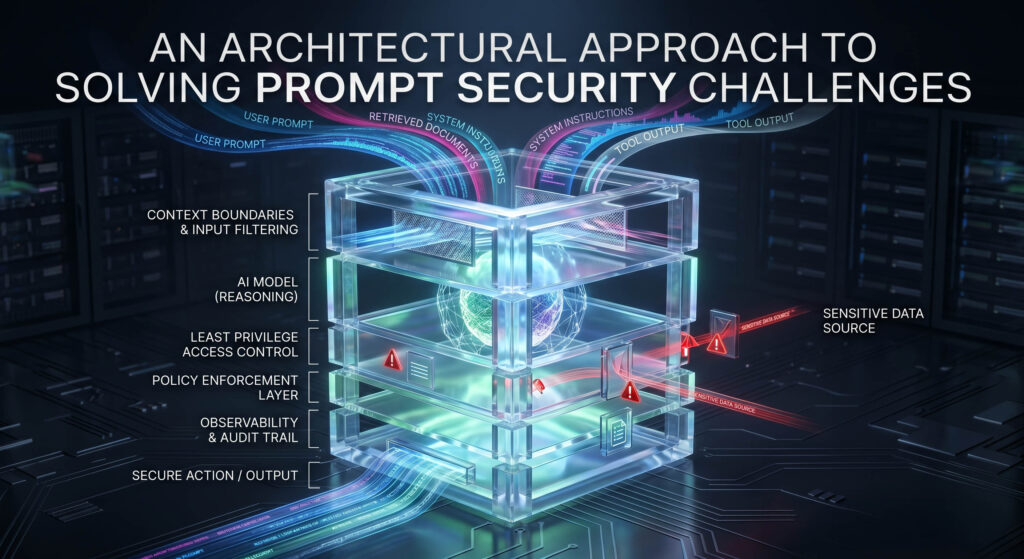
Enterprise IT and security leaders should focus on several architectural principles.
First, least privilege still matters. AI agents should only have access to the tools, data, and actions required for a specific task. A summarization assistant should not be able to message arbitrary recipients, modify system settings, or access unrelated business records. Narrow permissions reduce the damage that can occur if a prompt is manipulated.
Second, context boundaries need to be explicit. Retrieved documents, user instructions, system prompts, and external data should not all carry equal authority. Untrusted content should not be able to override trusted instruction layers. Systems need clear rules for which inputs can influence behavior and which inputs are treated only as reference material.
Third, high-impact actions need stronger controls. External communications, financial transactions, data exports, and configuration changes should not depend solely on a model’s interpretation of a prompt. These actions should require policy checks, approval workflows, or human review when risk is elevated. The goal is not to prevent AI from taking useful action. It is to ensure the architecture determines when action is appropriate.
Finally, observability must evolve. Security teams need visibility into how prompts, context, permissions, and tool use connect over time. They need to understand not only that an action occurred, but what instruction path led to that action. Without that lineage, investigators may only see fragments of a workflow whose risk becomes visible after the sequence is reconstructed.
Prompts Are Becoming Part of the Control Plane
As AI systems become more embedded in enterprise workflows, prompts are no longer just application content. They are operational instructions that influence what software does. In that sense, prompts are becoming part of the enterprise control plane.
That has practical implications. System prompts should be managed with the same discipline applied to identity policies, access rules, and configuration changes. They should be versioned, reviewed, audited, and restricted to authorized personnel. This discipline rarely exists today, and that gap is where unavoidable risk accumulates.
Prompt governance also needs to extend beyond the prompt itself. Enterprises should know which tools an AI agent can call, which data sources it can retrieve from, which users can modify its instructions, and which actions require additional approval. These controls must persist across the full workflow, not disappear after the first model response.
This approach requires closer collaboration between security, IT, software engineering, and business teams. Prompt security cannot live solely with AI developers. It touches identity management, data governance, application architecture, compliance, and incident response. Treating it as a narrow model-safety issue will leave important gaps.
Enterprise AI Requires Secure-by-Design Architecture
Generative AI is pushing software into a new operating model. Applications are beginning to reason across context, call tools, and act inside business workflows. That creates enormous opportunity, but it also requires a more mature approach to security architecture.
The enterprises that succeed will not be the ones that rely only on better models or broader employee training. They will be the ones that design AI systems under the assumption that instructions can be manipulated, context can be poisoned, and legitimate actions can combine into harmful outcomes. That mindset changes how teams think about permissions, observability, approval flows, and system design.
Prompt security will not be solved at the model layer alone. It will be solved by constraining the full chain of influence between instructions, data, tools, and actions. The next generation of security incidents will not look like breaches. They will look like the system doing exactly what it was told.
Mayank Kumar is the Founding AI Engineer at DeepTempo, where he leads the design and development of the company’s foundational Log Language Model (LogLM). With a strong academic and research background in generative and multimodal AI, he brings specialized expertise to building domain-specific models that enhance threat detection and response in cybersecurity environments.