Building An AM Quality Data Backbone That Makes AI Credible
By Tim Wischeropp, CEO, amsight

There is a sentence I hear more and more often in additive manufacturing: “We want to use AI.” It is usually said with good intent. The company wants to reduce scrap, shorten qualification loops, automate analysis, predict quality, optimise parameters, or make production more autonomous. These are valid goals. In fact, they are exactly the kind of ambitions AM needs if it is going to mature into a truly scalable production technology. But there is an uncomfortable question that must be asked before any serious AI discussion begins.
What exactly is the AI supposed to learn from?
Because if the answer is “machine logs in one folder, powder records in Excel, inspection PDFs in another folder, and a few tribal assumptions held by two experienced engineers,” then the AI project is not ambitious. It is premature.
This may sound provocative, but the AM industry does not have an AI problem. It has a data credibility problem. Too many organisations are trying to talk about artificial intelligence before they have created the conditions in which intelligence (artificial or human) can operate reliably.
AI does not create truth. It amplifies the quality of the data environment it is given. If that environment is fragmented, inconsistent, poorly labelled, or disconnected from process context, AI will not solve the problem. It will industrialise the confusion.
AM GENERATES DATA, NOT USABLE EVIDENCE.
One of the myths in additive manufacturing is that because the process is digital, the data foundation is automatically strong. This is not true. AM certainly generates data. Machines produce logs. Powder is tracked. Parameter sets are stored. Sensors record signals. CT scans, CMMs, and mechanical tests generate reports. Post-processing steps create additional evidence. Operators sign off work instructions. Maintenance activities are documented somewhere.
But generating data is not the same as building a usable evidence chain. The real challenge is not whether data exists. The challenge is whether powder history, machine state, build parameters, post-processing, inspection outcomes, and part-level conformity can be linked in a way that is consistent, queryable and trusted over time.
That distinction matters enormously for AI.
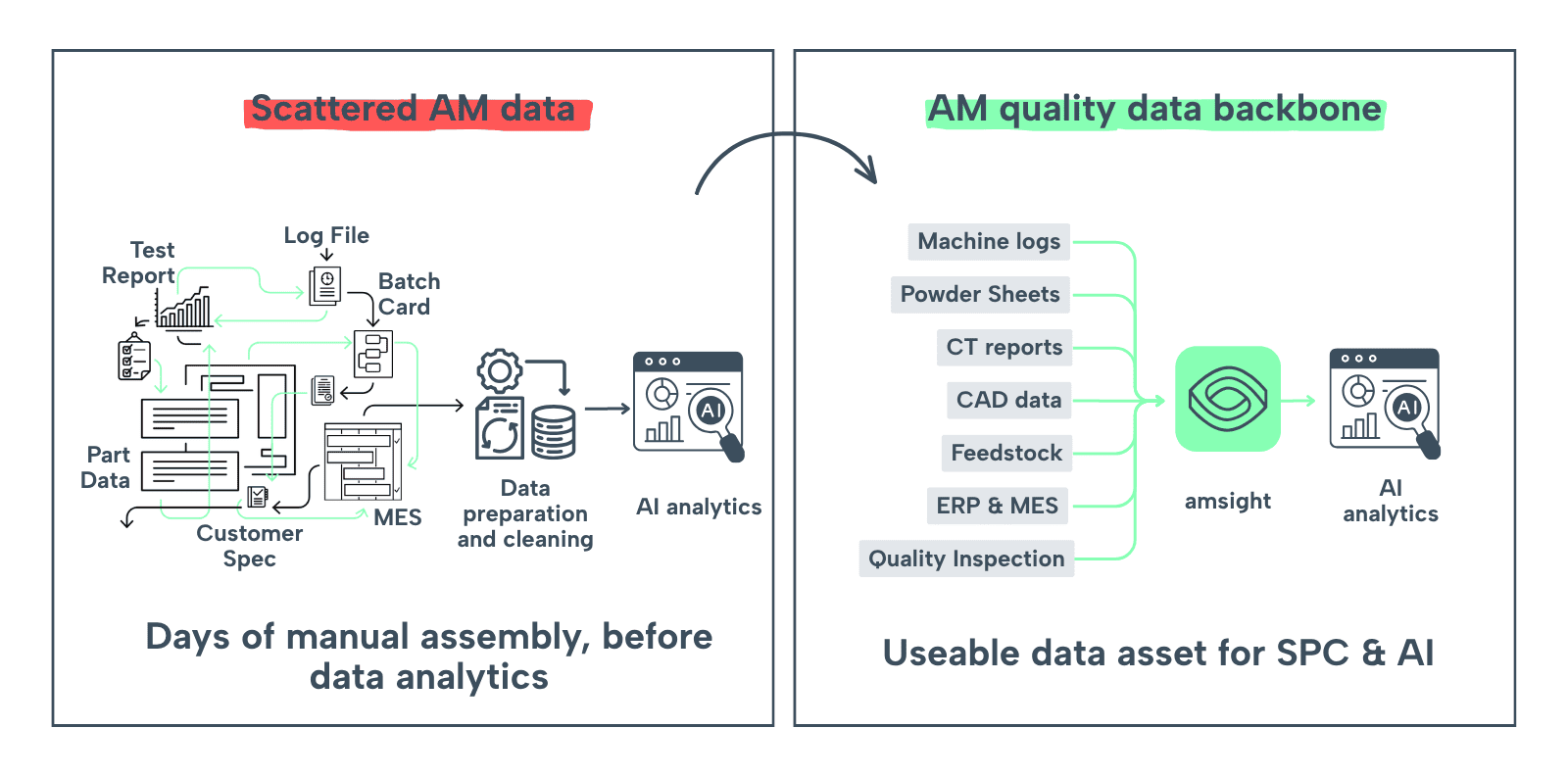
An algorithm does not simply need “more data.” It needs data with context. It needs to know which powder lot was used, how many reuse cycles were involved, which machine produced the build, whether maintenance had occurred, which parameter revision was active, which post-processing route followed, and which inspection result belongs to which part or coupon. It needs to know what changed, when it changed, and whether that change mattered. Without that connected context, AI becomes pattern recognition without accountability.
Figure 1: Connected context makes data usable for traceability, SPC, root-cause analysis, and AI.
The danger of “dashboard theatre”
The next years in AM will produce a lot of AI theatre. We will see attractive dashboards that claim to detect risk, predict defects, or recommend actions. Some will be valuable. Many will be impressive demonstrations built on weak foundations. The danger is that organisations mistake visual sophistication for process understanding.
A coloured warning icon is not quality management. A predicted anomaly is not root-cause analysis. A machine learning model that cannot explain the evidence chain behind its recommendation will struggle to survive the realities of regulated production.
This is especially important in sectors such as space, aerospace, defence, energy, semiconductor, and medtech. In these environments, quality decisions are not just technical decisions, they are accountable decisions. If an AI system recommends that a build is acceptable, a customer or auditor may eventually ask why. If the answer cannot be traced back to controlled data, validated assumptions, and documented process evidence, the recommendation is not credible.
AI must therefore be built on an AM quality data backbone, not scattered files.
What a quality data backbone actually means
It is not a generic data lake, a document repository, or an MES with extra attachments..
For AM, a quality data backbone is a structured system that connects the full production evidence chain around the part and process. It captures and normalises data from machines, powders, parameters, post-processing steps, inspection systems, and quality records. It links that information across builds and across time. It makes the data usable for traceability, reporting, SPC, root-cause analysis and, eventually, AI.
The word “backbone” is important. AI cannot be a floating layer above production. It needs a spine: a reliable model of the process that tells it what the data means.
This is where many AM organisations need to rethink their IT architecture. ERP remains essential for business truth. MES remains essential for execution truth. But AM needs a dedicated production-level quality software that owns quality truth (part-level evidence, powder genealogy, process history, inspection results, stability metrics, and repeatable reports.) Only then can AI move from experimentation to operational credibility.
SPC before AI
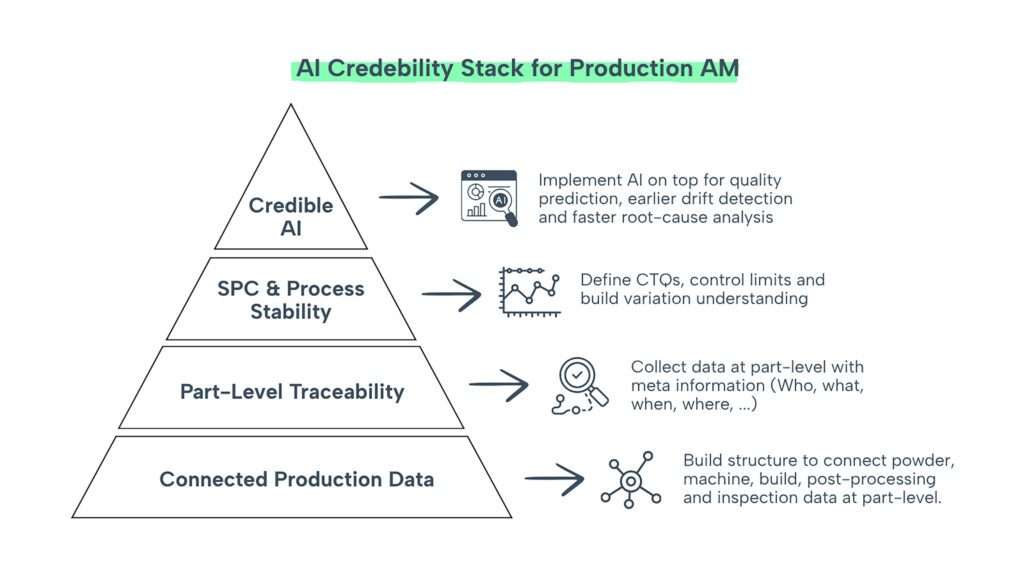
One of the mistakes companies make is jumping directly from manual reporting to AI prediction. That skips a crucial maturity step, statistical process control. SPC is not old-fashioned. It is one of the best readiness tests for AI in production AM.
If a company cannot define critical-to-quality characteristics, monitor process stability, detect drift, understand variation, and respond through defined control limits and reaction plans, then it is not ready to delegate judgement to AI. It is still learning how to describe its process.
SPC forces discipline. It asks, what are we measuring? Why does it matter? How stable is the process within a build and across builds? What input variables appear to influence the outcome? Which variations are normal, and which are signals of risk?
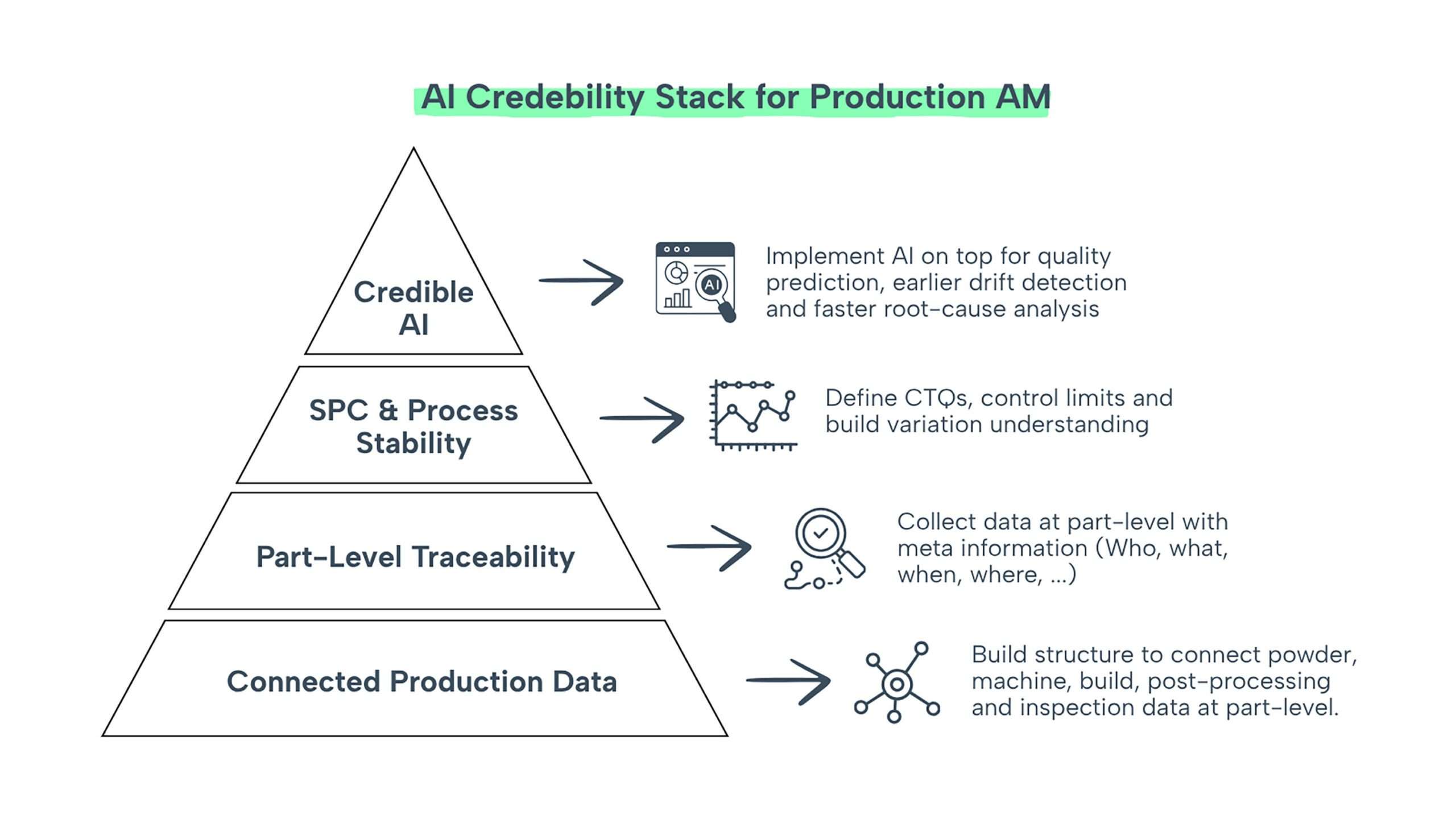
These are exactly the questions that make AI useful later. A mature AI strategy in AM should therefore not replace SPC. It should build on it. SPC gives the process its language. AI can then help recognise more complex relationships, accelerate analysis, and suggest earlier interventions. But without SPC discipline, AI risks becoming a black box sitting on top of a grey fog.
Figure 2: AI is only as credible as the quality backbone beneath it.
AI needs labels, and AM often hides them
In machine learning, labelled data is precious. In production AM, the labels are often buried. A part may be accepted or rejected, but why? Was the root cause powder condition, laser drift, parameter choice, build layout, post-processing variation, operator error, inspection uncertainty, or a maintenance event? Was it truly scrap, or was it accepted under deviation? Did it fail CT but pass mechanical testing? Did the coupon represent the part accurately? Was the parameter set later revised?
These details matter because they turn outcomes into learning signals. If organisations only store final reports, AI learns very little. It sees results, not reasons. It sees pass/fail, not process history. It sees defect categories, not the chain of events that produced them.
A quality data backbone turns production into a learning environment. Every build becomes more than an isolated event. It becomes a structured data point in an evolving understanding of the process. That is where AI becomes powerful.
The commercial reason to care
There is a practical commercial reason to build this backbone before chasing AI, and that is credibility.
Customers in regulated sectors do not want experimental intelligence. They want controlled intelligence. They want confidence that recommendations are grounded in traceable evidence and that data can support qualification, audit readiness, and continuous improvement.
If a supplier can show that its AI efforts are built on connected powder, process, and inspection data, the conversation changes. AI is no longer a marketing claim. It becomes an extension of quality maturity. This is powerful because the market is becoming more demanding. It is no longer enough to show a successful build. Customers increasingly want to know whether the supplier can reproduce quality, explain variation, prove conformity, and reduce risk as production scales.
The companies that can answer these questions with structured data will be in a stronger commercial position than those offering only machine capacity and enthusiasm.
What AM leaders should do now
The path does not begin with hiring a data scientist and asking for a prediction model. It begins with building the evidence chain.
Start with traceability. Link powder, build, post-processing, and inspection at part level. Standardise how quality data is captured. Reduce manual reporting. Define critical-to-quality attributes. Implement SPC where variation matters most. Make root-cause analysis faster by connecting machine events, maintenance, powder state, and inspection outcomes. Create repeatable reports that do not require forensic spreadsheet work.
Then, and only then, ask where AI can add value. Can AI help detect early drift? Can it identify correlations between powder reuse and quality outcomes? Can it suggest more targeted inspection? Can it shorten root-cause analysis by surfacing likely process changes? Can it support parameter development by learning from historical production evidence?
These are credible AI questions because they start from a credible data foundation.
The future is not AI versus quality management
Some people talk about AI as if it will replace quality management. I think the opposite is true. AI will make quality management more important, not less. As algorithms become more involved in production decisions, the need for structured evidence, traceability, governance, and accountability increases. The better the AI, the more important it becomes to understand what it was trained on, what it sees, what it does not see, and why its recommendations should be trusted.
For AM, this is a significant opportunity. The industry has always been data-rich, but it has not always been data-disciplined. AI gives us a reason to become disciplined faster.
At amsight, our view is clear, the future of AM quality will be data-powered, but only if the data is connected, contextualised and usable. The digital quality backbone is the enabling part. Without it, AI remains a slide in a strategy deck. With it, AI becomes a practical tool for supporting more reliable, lower-risk AM production at scale..
The companies that understand this will move faster. Not because they adopt AI first, but because they build the foundation that makes AI worth trusting. And in production AM, trust is the real technology.