Should the Front Office-Back Office Divide End?
By Dr John Bates

Document intelligence expert Dr John Bates on why enterprises may still benefit from retaining this front and back office division of functions, no matter what the enterprise suite vendors want us to think
The ‘front’ of an office inevitably sounds important; the ‘back’ suggests filing cabinets and, traditionally, bean counters.
Of course, that is not how businesses actually operate. The distinction between front office and back office is simply a convenient way of differentiating customer-facing and sales activities from the operational functions that support them.
But while the distinction once made sense in a physical world, does it still hold in a digital, automated one?
Historical backdrop
It’s believed that the whole idea of a separation between a front and back office originated in financial services three hundred or so years ago.
For much of the modern business era, this has been manifested by two teams physically sitting on different floors—people at the “front” of the business, sometimes literally near the building entrance, responsible for customers; and a less visible cohort of employees in a different part of the building handling the operational work that keeps the business running. As it was said: “The front office does the deal, but doesn’t settle the money; the back office settles the money, but doesn’t do the deal.”
For a long time, this arrangement made sense: high-contact activities could be decoupled from lower-contact tasks, allowing processes such as invoicing, HR and accounting to be handled more efficiently. Many of these functions were also heavily dependent on paper and physical records, making the distinction even more practical.
Although some parts of investment banking and other industries also have a middle office, the distinction between front and back office has persisted long after technology made such strict demarcation and physical separation necessary. Deutsche Bank, for example, had just under 90,000 employees at the end of 2024; just over a third were in front-office roles, while the majority worked across the infrastructure, technology, operations, compliance and other functions.
Let’s just have one office
A June 2025 analysis inThe Economist noted that traditionally back-office-oriented SAP and front-office-oriented Salesforce were acquiring complementary companies. More significantly, AI agents could finally bring the front-office/back-office divide to an end.
The argument is not simply that these companies are adding AI, but that they are evolving from departmental applications into platforms through which agents can orchestrate work across entire organisations. As Forrester puts it, are CRM, General Ledger and Accounts Payable systems evolving into an agent-based horizontal ‘business fabric’?
That vision will certainly appeal to some CIOs. But it also looks rather like a version of vendor lock-in. If vendors can persuade customers that their agents and acquisitions, such as Salesforce’s $8bn acquisition of Informatica, can handle front and back office equally well, there is an obvious incentive to keep enterprise data, governance and business logic within their particular walled garden.
That makes sense for the major enterprise software suites: many have customers using products from multiple rivals and would benefit enormously from consolidating their share of the $700bn global enterprise software market.
But here’s my problem: these big platforms cannot do everything today, so I see little basis for assuming they suddenly can across the enterprise. Anyone who has worked in enterprise IT knows that even the grandest “comprehensive” systems often need multiple third-party additions to work as advertised.
If extensions are needed to make today’s enterprise systems work properly, the idea that AI will turn an expanded SAP, Salesforce or similar platform into a single source of truth for the entire enterprise feels overstated. In practice, customers may want excellent back-office ERP or human capital management alongside front-office customer onboarding, but neither enterprise system is particularly good at handling the real focus of day-to-day business: the documents and business information constantly flowing between them.
Reports of the death of this divide are premature
Another reason not to declare the back office dead just yet is that it remains the repository, now electronic rather than paper, for the organisation’s financial, payroll, procurement and compliance records.
So while I can certainly envisage a future in which intelligent agents move across these boundaries on the company’s behalf, making the distinction invisible to customers, I cannot see how the underlying structure can ever entirely disappear within the organisation itself.
Given that even today some core workflows these big systems own still require additional support, I don’t think agents are yet robust enough to dissolve the distinction between applications.
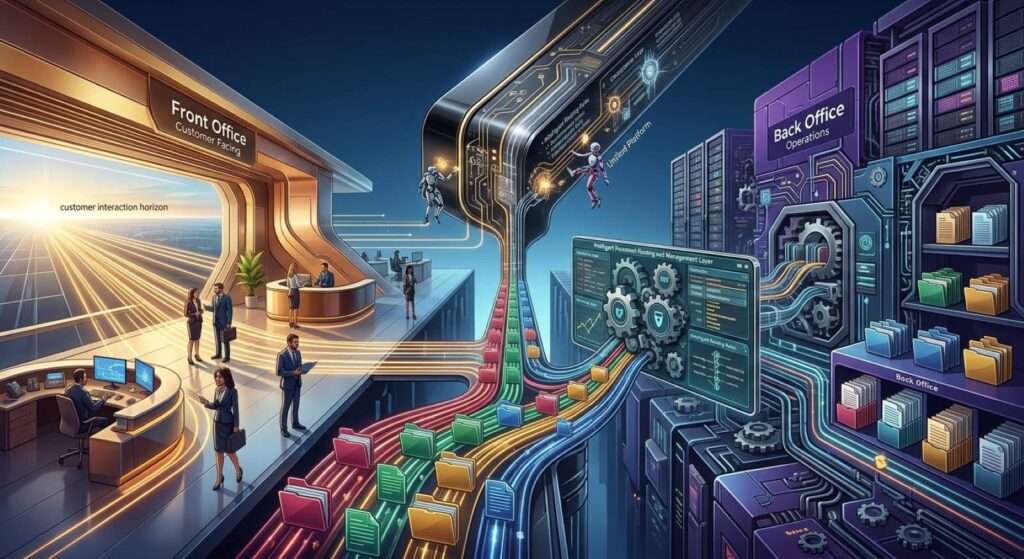
An evolved document management that acts as a middle office, will not only always be needed but may in fact start to become more important as agents proliferate, acting as the best rules-based way to route data and insights to their appropriate destinations.
Despite what the major software vendors may suggest, this three-century-old division is likely to remain relevant for many years to come.
Dr John Bates is CEO of document intelligence leader Doxis