Why “Agentic AI” in the SOC Still Needs Human Oversight
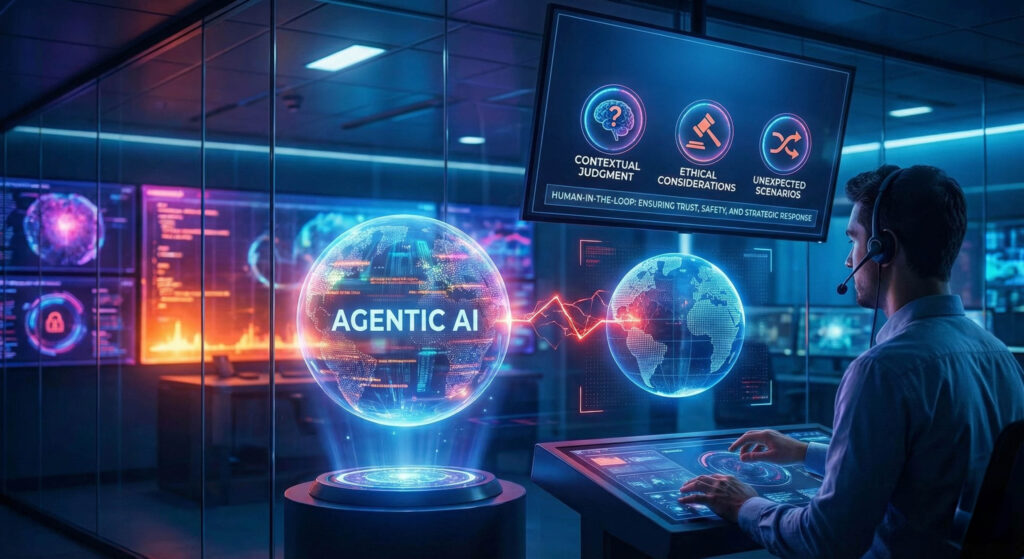
By now, you will almost certainly have heard – and are growing sick of hearing about – agentic AI. It’s become one of the most overused terms in cybersecurity marketing. Vendors promise autonomous investigations, self-directed remediation, and SOCs that “run themselves.”
But the reality is much more nuanced.
Agentic AI has the potential to transform security operations. AI SOC platforms dramatically accelerate investigations, reduce analyst work, and surface insights faster than traditional rule-based tools. But total autonomy creates enormous risk – human oversight is still as critical as ever.
The Rise of Agentic AI in Security Operations
In the simplest possible terms, “agentic AI in the SOC” refers to systems that can pursue investigative goals independently. For example:
- Chaining multiple investigative actions together
- Deciding what data to gather next based on findings
- Adapting their approach as new evidence emerges
This differs from traditional automation, which relies heavily on static playbooks and predefined decision trees. Ultimately, traditional automation merely executes single scripted tasks in response to stimuli. Agentic AI SOC tools, however, can reason through incidents more like a junior analyst – asking questions, correlating signals, and refining hypotheses as they go.
However, just like a junior analyst, you mustn’t grant agentic AI tools full autonomy.
Let’s dive deeper into that idea.
Agentic Autonomy Without Oversight is a Recipe for Disaster
Security incidents are inherently messy. They rarely, if ever, present themselves with clear intent or complete information. They unfold in environments defined by ambiguity, business constraints, and competing priorities.
It’s easy for agentic AI to make mistakes under these circumstances – and without human oversight, those mistakes can have disastrous consequences.
Agentic AI tools act quickly, but speed doesn’t equate to judgment. A suspicious pattern may actually be a sanctioned business process. An unusual login may be the result of a legitimate workflow change. Without human context, agentic AI can misinterpret intent and escalate situations that don’t warrant action.
The interconnected nature of agentic AI compounds risk. A flawed assumption early in an investigation influences every step that follows. The AI becomes increasingly confident, decisive, and mistaken. By the time a human intervenes, the damage is already done.
For example, an unsupervised agentic AI tool might mistakenly isolate endpoints, revoke access, or modify configurations. That can seriously disrupt operations.
Understanding Different Forms of Oversight
Now we understand why oversight is important, the next question is how it actually works in practice. Not all oversight slows AI down, and not all decisions require human approval. In a modern SOC, oversight falls into one of two categories.
Human on the Loop: Guiding and Improving AI Reasoning
Human-on-the-loop oversight doesn’t mean that analysts must approve every agentic AI action. Instead, they:
- Question the AI’s assumptions
- Ask follow-up questions during investigations
- Provide feedback on conclusions
- Instruct the AI to incorporate that guidance in future reasoning
This type of oversight means agentic AI can improve over time, without slowing investigations to a crawl. Analysts shape how the system reasons over time, aligning it with an organization’s risk tolerance, specific environment, and investigative standards.
Human in the Loop: Guardrails for High-Stakes Decisions
Human-in-the-loop oversight is slightly different. It involves analysts sitting at a critical decision point – that means the AI can recommend an action, but an analyst must approve it. It’s typically only necessary for actions that carry real risk, for example:
- Account suspension or privilege revocation
- Endpoint isolation or network containment
- Automated remediation changes
- Any action with legal, regulatory, or business impact
These decisions demand judgement, accountability, and awareness of downstream consequences. AI can inform them, but shouldn’t own them.
Choosing the Right AI SOC Platform
But please don’t read this as an argument against agentic AI itself. With proper oversight, it’s one of the most meaningful advances the SOC has seen in years.
Today’s agentic AI tools can gather and correlate data across tools, chain investigative steps together, adapt as new evidence emerges, and summarize findings. This work is repetitive and time-consuming – in a world where the average organization processes 960 alerts a day, and average investigation times sit at 70 minutes, that kind of automation is a lifesaver for overstretched analysts.
The problem is that many vendors claim their tools can do more than they actually can.
Agentic AI doesn’t understand business priorities, regulatory exposure, or the impact of enforcement actions. It can reason about signals, but it can’t reliably judge consequences. That’s why autonomy beyond investigation can escalate risk.
If you take one thing away from this blog, let it be this: don’t trust vendors claiming to offer fully autonomous SOCs. Look for those that clearly define where agentic autonomy ends and human oversight begins. You can find lists of reputable vendors online.
Agentic AI is an Evolution, not a Replacement
The need for human oversight is the single most compelling argument against the whole “AI is going to steal analyst jobs” debate.
In fact, it can make analysts’ jobs easier. It helps SOC teams at a scale that would otherwise be impossible. It takes over boring, mechanical work so that analysts can focus on decisions that really matter. But it only works with a human in, or on, the loop.

About the author:
Josh is a Content writer at Bora. He graduated with a degree in Journalism in 2021 and has a background in cybersecurity PR.
He’s written on a wide range of topics, from AI to Zero Trust, and is particularly interested in the impacts of cybersecurity on the wider economy.