Optical Networking At Micro Scale
By Brett Saddoris, Technical Marketing Manager, Accumold
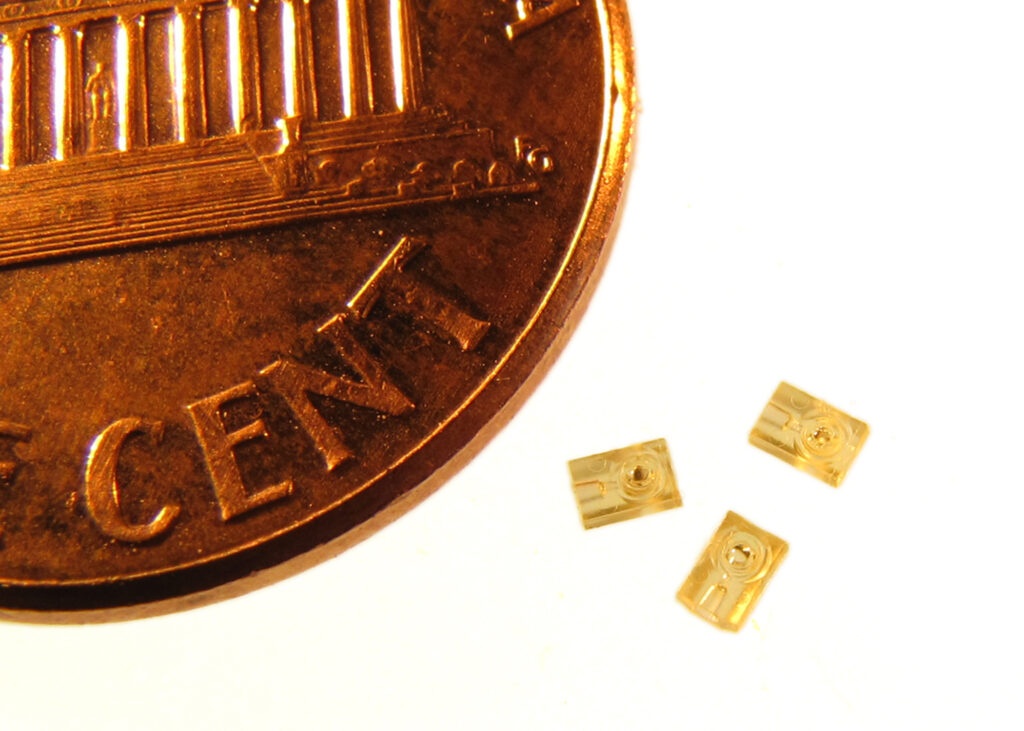
As optical networking hardware becomes smaller and denser, the performance of data centers increasingly relies on micro molded polymer components. These miniature structures protect delicate optical interfaces and hold critical alignment relationships in place during high-volume production. Micro manufacturing discipline enables the optical networking industry to scale precision and avoid the hidden program delays associated with tolerance variation.
We tend to describe the digital economy in weightless terms, cloud services, AI workloads, virtual machines, distributed computing. But the performance of everything upstream increasingly depends on something very physical downstream, namely the quality of the connections, alignments, interfaces, and packaging that move data at speed using light.
Optical networking is in the middle of a quiet step-change. Networks are densifying, transceiver architectures are evolving, connector counts are rising, and tolerances are tightening. The “next leap” in optical connectivity won’t be delivered solely by breakthroughs in photonics design. It will also be delivered by the manufacturing disciplines that can replicate precision at volume, particularly for the miniature polymer components that protect delicate optical interfaces, guide assembly, and hold critical alignment relationships in place.
That’s where micro molding comes into the story, not as a supporting player, but as a practical enabler. And it’s where the conversation increasingly converges with the expanding infrastructure behind modern computers. Data centers are scaling, and with them comes a growing appetite for optical interconnect solutions that are denser, more reliable, and more manufacturable.
This article isn’t about any one event or a specific market forecast. It’s about the intersection of three realities that optical designers and systems engineers are already living with:
- Optical networking hardware is becoming smaller and denser.
- The consequences of variation are increasing as tolerances tighten.
- The ability to scale production without losing performance is becoming a differentiator.
THE OVERLOOKED FOUNDATION OF OPTICAL PERFORMANCE
When most engineers think “optical networking,” they picture fibers, lasers, photonic integrated circuits, and transceivers. The polymer parts around those devices can feel mundane by comparison. Yet these parts frequently determine whether a design is robust in the field, or fragile.
Why? Because they influence the real-world conditions that optics must survive:
- Mechanical stability – holding geometry under vibration, handling, and time
- Alignment support – guiding components into precise relationships during assembly
- Interface protection – shielding sensitive surfaces from damage or contamination
- Cable management – routing and strain relief in ever tighter spaces
- Packaging density – enabling compact system-level layouts without compromising reliability
In other words, micro molded components often act as the “infrastructure of the infrastructure”, tiny structures that make optical performance repeatable outside the lab.
“MICRO” IN OPTICAL NETWORKING MEANS “FUNCTIONAL AT MICRON SCALE.”
In optical systems, the word micro is frequently misunderstood. It is not merely a reference to part size, it is a reference to feature fidelity, positional control, and repeatability.
At this scale, it’s not enough that a part is dimensionally “close.” The part has to behave consistently, because optical assemblies are sensitive to changes that would be irrelevant in many mechanical systems. Micro molding in this context often involves features that support precise fiber alignment and retention; stable datum structures for assembly location; controlled mating geometries, fine ribs, latches, micro channels, or guides used for routing and protection; and compact housings and retainers that enable high-density packaging
And that, in turn, requires a deep understanding of how tooling choices, gating strategy, and process control influence micro-scale outcomes.
WHY OPTICAL NETWORKING AND DATA CENTER DEMAND ARE CONVERGING
If optical networking is evolving, it’s not doing so in isolation. The back-end systems that rely on optical connectivity (particularly large-scale compute environments) are becoming more complex, more connected, and more performance hungry.
As these environments grow, several manufacturing pressures intensify:
- Volume pressure (more connections, more assemblies, more modules, more components)
- Reliability pressure (tighter performance requirements and longer service expectations)
- Density pressure (more function in less space)
- Thermal pressure (more heat in compact form factors)
- Time pressure (shorter deployment cycles and faster iteration)
These pressures affect the optics, but they also affect the “supporting cast” of micro components used in and around optical connectivity, connector subcomponents, alignment-related structures, protective housings, retainers, and guides.
In practice, this is where micro molding becomes increasingly strategic. When assemblies multiply, and every interface must perform consistently, the quality of the small components stops being a detail. It becomes a system-level variable.
SCALE MATTERS, BUT NOT IN THE SIMPLISTIC WAY PEOPLE THINK
A common misconception is that scaling micro molded components is simply a matter of “running more parts.” In optical networking, scaling is often harder because you are scaling precision, not just output.
When connector density increases and tolerances tighten, variability becomes more costly. Small deviations can lead to assembly friction, alignment drift, mechanical instability, or performance inconsistency. That’s why the manufacturing conversation has to evolve beyond “Can you mold it?” to questions like:
- Can you mold it repeatably across long runs?
- Can you maintain critical tolerances as cavity counts increase?
- Can you control dimensional drift over time and production changes?
- Can you detect micro-scale trends early and correct them before they become defects?
In the data center-oriented view, this is the difference between success and disruption. The cost of supplier error is rarely confined to the component, it cascades into qualification schedules, assembly workflows, and deployment timelines.
THE REAL RISKS: VARIATION, REVALIDATION, AND “HIDDEN” PROGRAM DELAYS
When projects slip in optical networking, it’s often not because the photonics design is flawed. It’s because manufacturing realities were underestimated, or discovered late.
Three common pitfalls show up repeatedly:
1) Underestimating tolerance sensitivity
Optical assemblies can be unforgiving. Components that “look fine” dimensionally may still drive performance variability if critical datums shift, surfaces distort, or mating features don’t behave consistently.
2) Treating supplier selection as transactional
When parts are micro-scale and performance-critical, “job shop” dynamics tend to break down. Projects need suppliers who can engage early on manufacturability risk, measurement strategy, and process discipline.
3) Supplier transitions that trigger revalidation
Changing suppliers mid-program can be particularly disruptive when tooling and processes must be replicated, or when subtle differences introduce new variation. Revalidation is time-consuming and expensive, and the hidden cost often exceeds any short-term savings.
The takeaway is simple. In high-density optical connectivity, predictability is not a “nice-to-have.” It’s a program requirement.
MATERIALS
Optical networking isn’t just about geometry. It’s also about how materials behave under real operating conditions. As systems densify and thermal loads increase, polymer choices become more consequential.
High-performance thermoplastics (such as LCP, PEEK, and Ultem) are increasingly relevant where stability, heat resistance, and long-term mechanical performance matter.
But these materials can be demanding to mold, especially in micro forms. Getting them right requires tight control of flow dynamics, gating design, and cycle parameters to avoid internal stresses that compromise function.
In optical networking applications, that matters because long-term drift, warpage, or subtle stress effects can influence alignment and assembly behavior. The best manufacturing partners treat material selection as part of performance engineering, not as a procurement decision.
PROCESS CONTROL AND MEASUREMENT
In micro molding, quality is not simply an inspection outcome, it’s the result of process discipline. The manufacturing realities are practical, repeatability, long-term dimensional stability, and robust inspection approaches become increasingly critical as connector density rises and tolerances tighten.
In a high-stakes environment, resilience is also about predictability, being able to hold tight tolerances across large quantities, and identifying trends before they become defects.
That requires a partner that can translate micro features into measurable, controllable parameters. It’s not glamorous, but it is exactly what enables optical networking to scale without compromising performance.
WHERE ACCUMOLD FITS
This is not a promotional article, and it shouldn’t be. Optical networking teams don’t need marketing, they need manufacturing confidence.
What can be said, without exaggeration, is that Accumold’s experience in micro molding is built around the exact challenges this sector is now encountering, micro-scale repeatability, material performance under demanding conditions, and production readiness when volume and consistency both matter. The focus (particularly in programs tied to optical and electronic infrastructure) is on delivering precision that can be replicated at scale, not just achieved once.
If you’re designing optical systems that must perform reliably across high deployment volumes, the smartest move is often to involve manufacturing expertise earlier than feels necessary. Not because your design is weak, but because the real-world success of optical networking increasingly depends on the manufacturing details no one notices, until they fail.
SUMMARY
Optical networking is entering a phase where density and performance demands rise together. Data infrastructure growth is amplifying that shift, but the underlying truth is broader. As optical systems become more compact and more ubiquitous, manufacturability becomes inseparable from innovation.
Micro molding sits at the intersection of those trends. It enables miniature components that protect sensitive interfaces, maintain alignment, manage routing, and support compact packaging, at the repeatability and scale that modern optical systems increasingly require.
The companies that win in this environment will be those that treat manufacturing not as a back-end step, but as a front-end strategy, selecting partners that can translate optical intent into repeatable production reality, and doing so in a way that keeps performance stable as demand grows.
That’s the quiet truth behind the “next leap” in optical networking. It will arrive through breakthroughs in photonics, but it will be delivered, at scale, through disciplined micro manufacturing.
Brett Saddoris is Technical Marketing Manager at Accumold. The company has grown to a 130,000 square foot fortified facility designed for assurance of supply, employs over 350 staff, and is a net exporter shipping all over the world every day from its Ankeny, IA, USA facility which runs 24 hours a day, 7 days a week.