Conversational Messaging Was BFCM’s Quiet Power Move
Key Takeaways:
- BFCM 2025 revealed a shift toward conversational messaging, with channels like RCS surging as shoppers sought faster, more personal engagement during high-stakes moments.
- Despite strong consumer demand, many brands still underuse conversational commerce due to siloed teams, legacy systems, and hesitation around automation.
- The most effective strategies blended AI-driven automation with easy access to human support, driving higher conversions, satisfaction, and loyalty.
- Conversational messaging isn’t a seasonal tactic but a long-term growth strategy that builds trust, shortens the path to purchase, and aligns with shoppers’ preferences.
Every holiday season, the pattern repeats: inboxes fill, ads flood every feed, and brands battle over ever-slimmer margins. Black Friday and Cyber Monday (BFCM) 2025 were no exception.
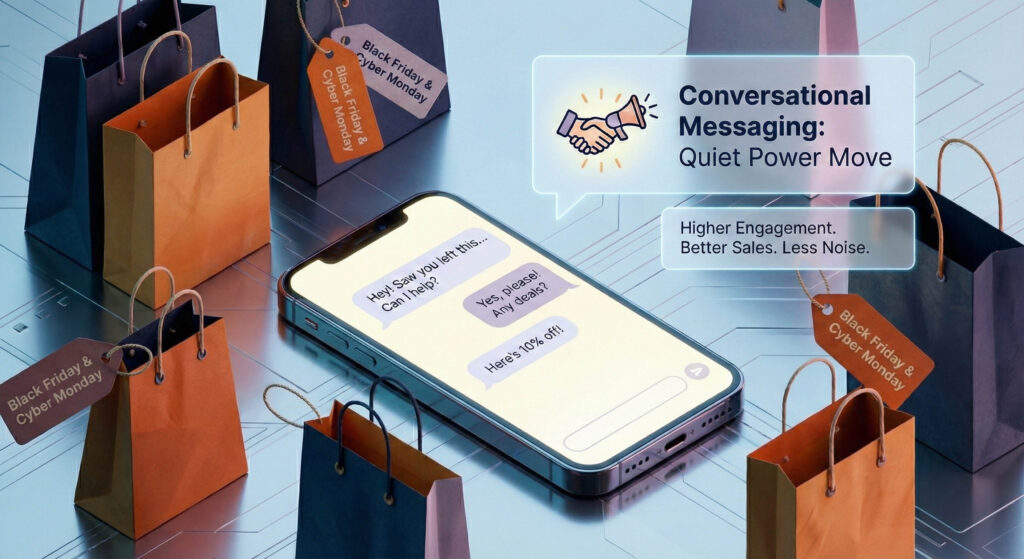
But this year, something else stood out. Conversational messaging, especially RCS, surged. In fact, RCS volumes saw the strongest year-over-year growth of any messaging channel, according to recently released data. That shift reflects more than a tactical adjustment; it signals a deeper change in how shoppers want to engage when the stakes are high.
When urgency peaks and attention spans shrink, shoppers don’t want more messages. They want better ones — faster, more personal, and more helpful. And increasingly, they want to engage in channels where they feel heard.
Why conversational messaging still isn’t core to commerce strategy
Despite broad consumer interest, conversational messaging remains underutilized, especially during high-traffic events. Adoption of conversational commerce is growing but still falls short of its potential due to integration complexity, organizational silos, and hesitation around automation.
Many brands still default to one-way, campaign-style communications because it’s what their martech stack and team structure were built for. Real-time messaging requires different systems and different thinking. It lives in the space between marketing and service, and that’s often where things stall.
Even though billions of people interact with chatbots like ChatGPT, consumers remain wary of fully automated experiences. What they want is speed with the option for support. Brands that can blend the two — automation for convenience, humans for complexity — stand to gain far more than short-term conversions.
Conversational messaging aligns with how younger shoppers buy
Younger cohorts, like Millennials and Gen Z, are often more likely than older shoppers to stick with brands that communicate conversationally, not just through promotional blasts, but through real-time, two-way messaging channels like WhatsApp, RCS, or even chats within owned apps. These customers want quick answers, personalized recommendations, and updates that feel like dialogue, not noise.
BFCM 2025 only sharpened this expectation. Shoppers facing out-of-stock items, last-minute delivery concerns, or promo confusion turned to messaging channels for clarity. Brands that could respond in the moment often kept the sale. Those that couldn’t? Likely lost it.
And this wasn’t just a holiday pattern; it’s a glimpse into how shopping behavior is shifting all year long.
What successful messaging actually looks like
In practice, conversational messaging isn’t about adding a chatbot. It’s about redesigning moments across the customer journey. The most effective strategies this season shared a few traits:
- Personalized product recommendations based on shopper input.
- Checkout flows embedded in messaging channels (no redirects or dead ends).
- Proactive post-purchase updates and clear return options.
- Easy access to human help when needed.
Retailers using this model saw stronger outcomes across the board. Messaging helped lift conversions by up to three times over mobile web. Others saw higher average order values and repeat purchases thanks to better mid-journey support.
Automation helped — but only when paired with human support
One of the strongest takeaways this season? Automation works best when it’s not invisible. Retailers that scaled successfully used bots for speed, then handed off to humans for nuance.
That hybrid model is becoming the new standard. Industry forecasts suggest that AI‑powered messaging and conversational experiences will redefine customer expectations and scale interaction volumes, transforming two‑way communication from a support channel into a growth engine. According to this 2026 outlook, conversational messaging — when embedded with AI agents and unified workflows — will be central to customer experience strategies that drive loyalty and long‑term value.
Another report found that conversational AI helps businesses reduce customer service costs by up to 70%. When clear escalation paths are in place, customer satisfaction follows. And satisfaction is the foundation of loyalty, especially during stressful or time-sensitive moments.
Messaging isn’t a seasonal solution. It’s a strategic one.
For many brands, BFCM was a missed opportunity to just connect with customers, not just focus on converting them.
As the dust settles, the smarter move isn’t to look back. It’s to look ahead. Retailers planning Q1 and Q2 initiatives should ask: How do we meet customers where they are, not just when we need to sell, but throughout the relationship?
Looking ahead to 2026, industry predictions point to a major shift: AI-powered conversational messaging won’t just enhance service — it will redefine how brands build trust and drive growth. As customer expectations rise, the ability to blend intelligent automation with human support will become a baseline for loyalty and differentiation.
Conversational messaging answers that challenge. It shortens the distance between question and purchase, reduces support overhead, and builds trust in real time. It’s not about being everywhere. It’s about being available, relevant, and responsive where it matters most.
The takeaway isn’t what happened this season. It’s what it revealed: Brands that turn conversations into strategy will be the ones customers come back to again and again.

Jonathan Bean is an award-winning go-to-market executive and entrepreneurial business leader with a proven track record of scaling technology-driven businesses through high-growth phases. As Chief Marketing Officer at Sinch, a global leader in cloud communications (CPaaS), Jonathan has played a pivotal role in transforming the company from a regional player into a Nasdaq-listed, category-defining brand with over $900 million in annual recurring revenue, more than 4,000 employees, and 800 billion+ customer engagements per year.